
Finishes & hardware · Northern Virginia
How to Mix Metals in a Room Without Them Clashing
Mixing metals works when you choose one dominant finish for the room’s largest fixtures, keep a second accent metal that contrasts clearly, and avoid a third unless it’s structural or fixed. Brass and matte black pair naturally. Chrome and brushed nickel read as a near-match that missed rather than an intentional combination. Intentional contrast is the goal. Accidental similarity is not.
The old rule was “all your metals must match.” Polished chrome faucet, polished chrome hardware, polished chrome towel bar. That rule is gone, and good riddance. Mixed metals read as more sophisticated than a perfectly matched set, when they’re mixed with intention. The problem is that most people mix by accident rather than by design, and the result reads as confusion rather than confidence. Here’s how to do it on purpose.
Choose one dominant metal
Pick one metal finish to use on your room’s largest or most prominent fixtures, typically the plumbing fixture in a kitchen or bath, or the light fixture in a living space. That dominant finish should appear in two-thirds or more of the metal moments in the room. The secondary finish is an accent, not a competitor. Give the room a clear leader.
Think of it as a lead actor with supporting characters. In a Northern Virginia kitchen with unlacquered brass on the faucet and cabinet pulls, that brass is the lead. Matte black pendant lights can play the second role beautifully, because they contrast clearly and don’t compete for the same visual register. But if you also add brushed gold hardware on the range hood and satin nickel hinges, you now have four metals and no clear hierarchy. The room feels restless. It is the same dominant-and-accent thinking behind the 60-30-10 color rule, applied to finishes instead of color.
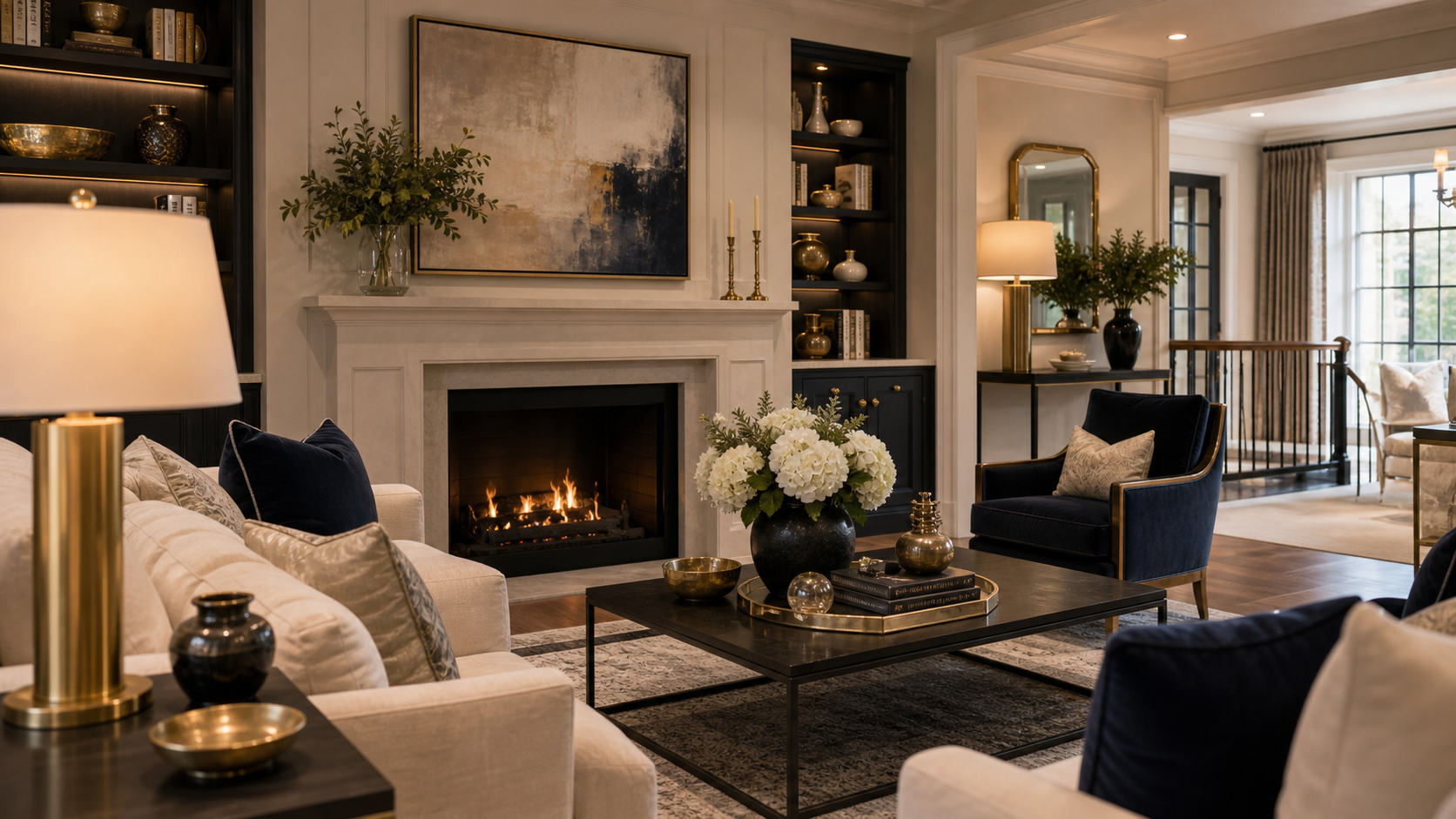
The dominant-accent model works for every room type. In a primary bath: brushed nickel plumbing as the dominant, matte black towel bars and accessories as the accent. In a living room: brass lamp bases and fireplace surround as the dominant, matte black coffee table legs and art frames as the accent. The anchor is always whichever finish appears first on the thing you spend the most time looking at.
Which metals actually pair well together
Brass pairs with matte black, warm bronze, and unlacquered copper. Brushed nickel pairs with chrome and brushed stainless. Matte black pairs with almost anything because it reads as a neutral. The combinations that clash are those where two metals are close in color temperature but different in finish, like polished brass next to polished gold, or brushed nickel next to satin chrome. Close is worse than contrast.
The underlying principle is that contrast needs to be legible. Your eye registers two metals as intentional when they’re clearly different. It registers them as a mistake when they’re almost the same. Polished chrome and brushed nickel live in the same cool-silver family, and the difference between them reads as someone couldn’t find an exact match. Polished chrome and unlacquered brass live in visually separate territories, so the combination reads as a design decision.
Warm metals go with warm metals. Cool metals go with cool metals, the same temperature logic that governs how you mix wood tones. Matte black is the universal bridge. When you have warm brass as your dominant and want a second finish, choose another warm metal as an accent (warm bronze) or go to matte black for maximum contrast. Don’t cross into cool silvers or it will look like you couldn’t decide between two different schemes.
Room-by-room guidance
In a kitchen, the faucet and cabinet hardware carry the dominant metal. Light fixtures and the range hood can carry the accent. In a bathroom, the plumbing fixtures (faucet, shower valve) are the dominant; towel bars and accessories are the accent. In a living room, the lamp bases and fireplace accessories are the dominant; side tables and art frames carry the accent. Each room gets its own clear anchor.
Kitchens are the room where this decision matters most, because you have so many metal touch points: faucet, cabinet pulls, knobs, pot filler, range knobs, light fixtures, range hood. Getting one dominant finish across the plumbing and hardware and letting light fixtures be a different accent is the standard high-end approach. It’s the pattern you’ll see in any well-finished kitchen in McLean or Great Falls.
Bathrooms introduce a challenge that kitchens don’t: all plumbing is usually from one manufacturer family, so the faucet, shower valve, shower trim, and tub filler arrive in matched sets. Choose the best set for your dominant finish and then use the accent sparingly on accessories, mirrors, and lighting. Shea Studio’s bath projects typically hold to one plumbing finish and introduce the second metal only in lighting, mirrors, and small hardware.
| Dominant metal | Best accent pairings | Avoid pairing with |
|---|---|---|
| Unlacquered brass | Matte black, warm bronze | Polished chrome, brushed nickel |
| Brushed gold / satin brass | Matte black, warm bronze | Polished chrome, polished nickel |
| Brushed nickel | Chrome, brushed stainless | Unlacquered brass, warm bronze |
| Matte black | Brass, bronze, chrome, nickel | Very few — it reads as a neutral |
| Polished chrome | Brushed nickel, stainless | Warm brass, bronze |
What to do with fixed metals you can’t change
If you have existing plumbing in polished chrome and want to add warm brass accents, the gap between them is too wide to bridge without one looking wrong. Swap the accessories (towel bars, toilet paper holder, cabinet pulls) to chrome to unify the room, or repaint fixtures if budget allows. Working around a fixed metal means doubling down on it rather than fighting it with a close competitor.
This comes up constantly in renovations. Someone keeps the original chrome plumbing in a guest bath and wants to update the feel. Adding unlacquered brass pulls and brass mirror is tempting, but warm brass next to polished chrome looks like two entirely different design choices crashed into the same room. The right move is choosing between going all-chrome with chrome accessories, or committing to a full fixture replacement so the plumbing matches the new direction.
If a full replacement isn’t in the budget, lean on matte black as a bridge. Matte black accessories read as a deliberate dark neutral, which can hold polished chrome plumbing and warm-wood cabinets together without forcing them into conversation. It’s not a perfect solution, but it reads as intentional where mixing warm and cool metals does not. For a complete picture of how finish choices fit into the larger goal of a cohesive home, see our guide on making a home look cohesive.
Let us get the finishes right
Shea Studio Interiors specifies hardware, plumbing, and lighting finishes for every project across Northern Virginia and Metro DC. We’ve been coordinating metal palettes for 30+ years and know exactly which combinations hold together and which don’t.
Frequently asked questions
Should all cabinet hardware match exactly in a kitchen?
No, but they should share a finish family. Mixing unlacquered brass pulls on base cabinets with brushed gold knobs on uppers can work if both are warm. Mixing unlacquered brass with polished chrome, even in the same room, reads as indecision. Choose one finish for all cabinetry hardware, then let the accent appear in lighting or plumbing instead.
Can you mix brass and chrome in a room?
Technically yes, but it’s difficult to make look intentional because brass is warm and chrome is cool. The two metals live in opposing temperature zones, and unless the rest of the room is designed to bridge them, the combination reads as two different design directions. Most designers avoid it. When brass is the dominant, choose matte black as the accent instead of chrome.
How many different metals in one room is too many?
Two is the standard. Three is possible if the third is structural or fixed (stainless appliances, for example) and reads as a neutral rather than a designed finish. Four distinct metals in one room almost always reads as chaos. If you count that many in a room you’re planning, consolidate before you finalize selections.
What metals work well in a bathroom?
Brushed nickel paired with brushed stainless is clean and contemporary. Unlacquered brass with warm bronze is rich and layered. Polished chrome with brushed nickel is classic but requires both to be from similar temperature families. Matte black with almost anything reads as modern and intentional. The key is clear dominant-accent hierarchy with your plumbing carrying the dominant finish.
What if I already have chrome plumbing but want a warmer look?
Your clearest options are: replace the plumbing fixtures (faucet, shower valve) to match your new warm direction; or lean fully into chrome with chrome accessories and pivot the warmth to wood, stone, and textiles instead. Layering warm brass over existing chrome plumbing creates a visual conflict the eye keeps trying to resolve. Commit to one direction.
Can metals on different levels of a room mismatch?
Distance helps. A brass floor lamp base and polished chrome kitchen faucet in an open-concept great room are far enough apart that the room doesn’t force them into comparison. The problem is when competing metals appear in close proximity, like two different finishes on the same wall, or a warm-metal faucet directly flanked by cool-metal towel bars. Proximity amplifies the mismatch.
or call 703-891-1570