
Interior design · Northern Virginia
What Is Transitional Design Style? A Designer’s Plain-Language Answer
Transitional design style blends traditional architecture and furnishings with contemporary finishes and a restrained palette. It keeps the warmth and detail of traditional design: crown molding, turned legs, upholstered pieces, but strips away fussiness in favor of cleaner lines, neutral grounds, and fewer ornamental layers. The result is a room that feels both comfortable and current.
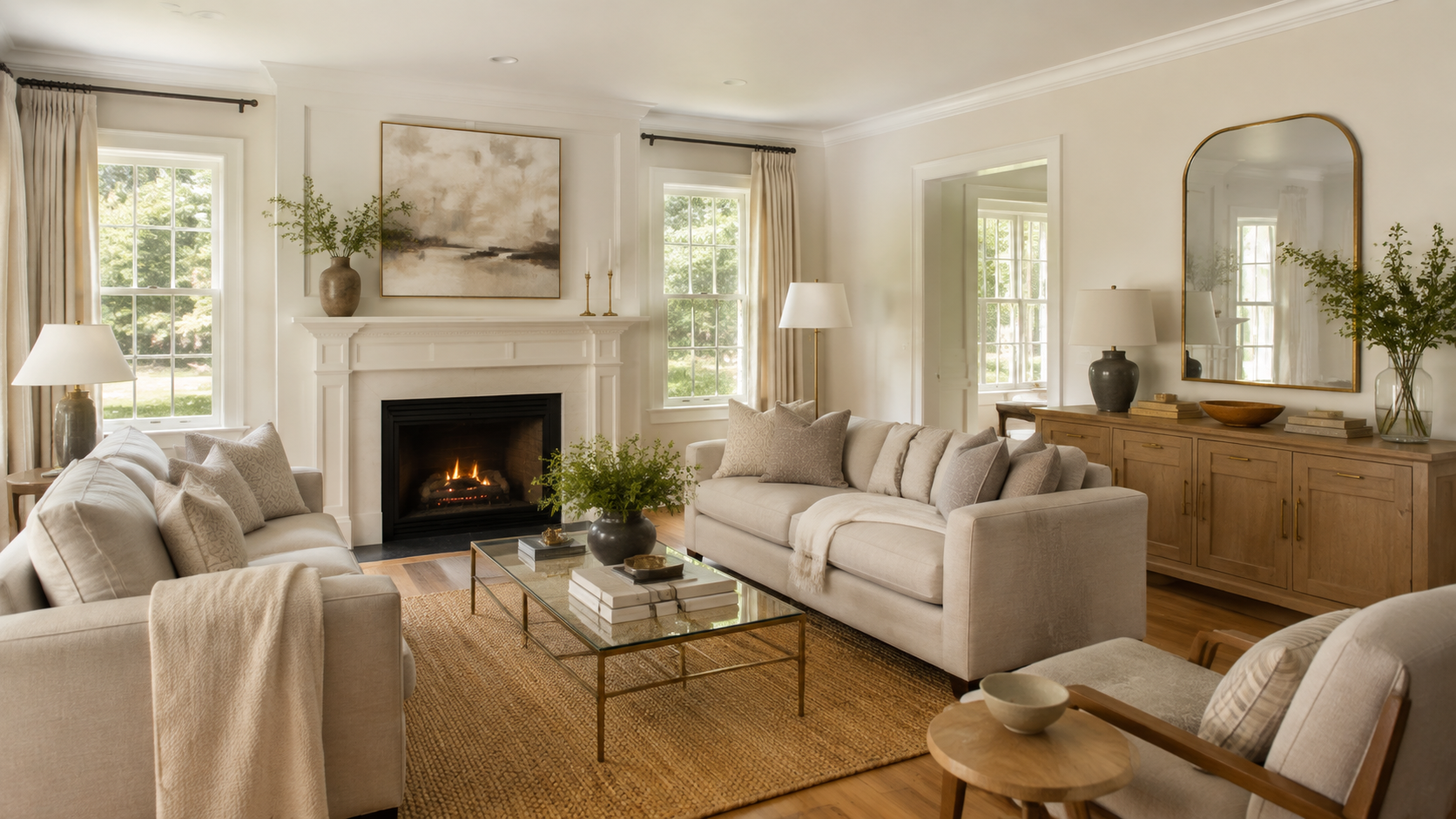
How transitional differs from traditional and contemporary
Traditional design is symmetrical, layered, and ornate: carved wood, patterned fabrics, rich color. Contemporary is minimal, asymmetrical, and material-focused: flat fronts, mono-material surfaces, bold or neutral extremes. Transitional borrows selectively from both: the symmetry and comfort of traditional, the palette restraint and clean finishes of contemporary.
A purely traditional room might have a carved-leg camelback sofa in a floral fabric, fluted columns on the fireplace surround, and silk drapes with tassel trim. A purely contemporary room might have a platform sofa in solid charcoal bouclé, no window treatment, and a single piece of abstract art on an otherwise bare wall. The transitional version sits between them: a sofa with a slightly curved back and tapered legs (traditional proportion, contemporary simplicity), solid or geometric fabric, a fireplace with simple clean-lined millwork, and layered window treatments that are tailored rather than formal.
The mistake most people make when trying to execute transitional is not going neutral enough on the palette. Traditional allows pattern-on-pattern and saturated color because all the layers are expected. Transitional trades those layers for space, so the palette has to carry more visual interest on its own through texture and tone variation rather than pattern multiplication.
The palette of transitional design
Transitional palettes run neutral-dominant with warm, earthy undertones: creamy whites, warm grays, greiges, soft taupes, and natural linens. These grounds are anchored by one or two accent colors pulled from nature: sage, aged brass, dusty blue, terracotta in muted form. Saturated color appears selectively in art, a single accent chair, or a lumbar pillow, not across multiple surfaces.
The neutral ground is non-negotiable in a well-executed transitional room. It is what creates the breathing room that distinguishes transitional from traditional. Walls and large upholstery pieces typically read as one cohesive neutral family. The variation comes from texture: a linen sofa reads differently from a velvet chair in the same warm taupe, and that contrast does the work that pattern would do in a traditional room.
Accent color in transitional design is chosen, not accumulated. One aged brass lamp, a sage velvet accent chair, and a dusty blue throw are enough. Adding a fourth color typically tips the room toward something that no longer reads as transitional. The 60-30-10 color rule applies cleanly here: the 60 percent is the neutral ground (walls and large seating), the 30 percent is a secondary tone (wood tones, secondary upholstery), and the 10 percent is a single accent color. See our guide to the 60-30-10 rule for the full framework.
Furniture profiles in transitional rooms
Transitional furniture keeps traditional proportions: substantial upholstered pieces, dining tables with aprons, chairs with turned or tapered legs, case goods with simple raised panel doors. The contemporary edit removes ornamentation: no carved crests, no claw feet, no decorative nail head borders unless used sparingly as the single detail on an otherwise plain piece.
The sofa is typically the most telling piece. A traditional Chesterfield is fully tufted, rolled arm, turned legs: beautiful but emphatically traditional. A contemporary track-arm sofa is flat-backed, square-armed, block feet: clean but cold. The transitional answer is a sofa with a slightly flared or gently curved arm, tapered legs in a natural wood or brushed metal, minimal or no tufting, and a solid or subtly textured fabric. It reads as recognizable and comfortable without announcing a historical period.
Case goods in transitional rooms often use Shaker-influenced door profiles: flat center panel with a simple frame, no raised molding, no carved decoration. This is the furniture profile that bridges most naturally because Shaker design is inherently restraint-oriented while remaining warm through natural wood grain and proportion.
Hardware and metals: the transitional approach
Transitional rooms use brushed or satin metal finishes rather than high-polish or antique. Brushed nickel, satin brass (unlacquered), and matte black all read transitional. Polished chrome is too contemporary; oil-rubbed bronze is too traditional. Mixing two metal finishes intentionally works in transitional design as long as one clearly dominates.
The metal finish choice is one of the clearest signals a room sends about its style register. Unlacquered brass ages to a warm, lived-in tone that aligns with transitional’s warmth without reading as formal or period. Brushed nickel is cooler and cleaner, more contemporary-leaning. Either works; what matters is that one metal dominates (at least 70 percent of visible fixtures and hardware) and the secondary metal coordinates through undertone rather than contrasting sharply.
For guidance on mixing metals across a room, see our answer to how to mix metals in a room and our companion piece on whether hardware and metals need to match.
Why transitional works so well in Northern Virginia homes
Northern Virginia’s housing stock skews toward Colonial, Federal, and traditional-influenced architecture built in the 1970s through the 2000s. These homes have strong traditional bones: formal entry halls, symmetrical facades, panel molding, and fireplace surrounds. Transitional design respects that architecture while updating it so the interiors do not look like a period preservation project.
A Fairfax County Colonial built in 1988 typically has a chair rail in the dining room, crown molding in the living room, and a fireplace with a built-in surround. Stripping all of that and installing a minimal contemporary interior creates a jarring conversation between the architecture and the furnishings. A traditional interior risks feeling like the owners never updated anything since the house was built.
Transitional keeps the millwork, updates the palette from hunter green and burgundy to warm cream and sage, replaces heavy drape-and-valance with tailored linen panels, and selects furniture that honors the room’s proportions without period furniture’s formality. The result feels like the house grew up gracefully rather than being either preserved or gutted. This is why the majority of the full-service residential projects Shea Studio has completed in Fairfax, McLean, and Alexandria over the past decade land in the transitional category.
Designing a transitional interior?
Shea Studio Interiors has designed transitional interiors for Northern Virginia and Metro DC homes for more than 30 years. We know how to honor traditional architecture while creating rooms that feel current, comfortable, and genuinely livable.
Frequently asked questions
Is transitional design the same as traditional design?
No. Traditional design is symmetrical, layered, and ornate with period-specific details: carved furniture, patterned fabric, formal window treatments, and saturated color. Transitional keeps traditional proportions and warmth but removes ornamentation, restores the palette to neutrals, and introduces contemporary finishes. The result shares comfort with traditional but feels less historical and more current.
What colors are typical in transitional design?
Transitional palettes are neutral-dominant: warm whites, greiges, soft taupes, and natural linens form the ground. One or two accent colors from a muted natural range, such as sage, aged brass, dusty blue, or terracotta, appear selectively rather than across multiple surfaces. High-chroma, saturated color is used sparingly, in art or a single accent piece, not as a room’s primary tone.
What furniture styles work in a transitional room?
Transitional furniture keeps traditional scale and upholstered comfort but removes carved detail, heavy ornamentation, and period-specific legs. Look for: sofas with gentle curves and tapered legs, Shaker-influenced case goods with simple flat-panel doors, dining chairs with upholstered seats on clean frames, and case pieces with brushed or satin metal hardware rather than antique brass or cast pulls.
Can transitional design work in a modern home?
Transitional design is more commonly applied to homes with traditional architectural details, where it bridges the existing bones toward a current sensibility. In a truly contemporary home with flat ceilings and minimal trim, a transitional interior can read inconsistent rather than balanced. Contemporary homes pair better with a contemporary or mid-century interior; transitional works best where there is some traditional architecture to work with.
Is transitional design out of style?
Transitional is one of the most durable design approaches precisely because it is not a trend. It does not reference a specific decade, it does not rely on a material that will cycle out, and it appeals to a wide range of personal aesthetics. Rooms designed in a careful transitional approach from twenty years ago still read as well-composed today. That longevity is a feature, not a limitation.
What is the difference between transitional and classic design?
Classic design typically refers to a timeless, restrained version of traditional design grounded in European architectural references: symmetry, quality materials, and proportional correctness without trendy elements. Transitional is a broader term that describes a blend of traditional and contemporary sensibilities with a specifically restrained palette. Classic leans more firmly toward traditional; transitional sits closer to the midpoint between the two.