
Design principles · Northern Virginia
Should Hardware, Metals, and Trim All Match Throughout the Whole House?
No, they don’t need to match exactly, but they do need to be related. A deliberate metal palette: one dominant finish, one secondary, one accent, held consistently across a home, creates cohesion without rigidity. What you’re avoiding is accidental mismatching, the result of four separate decisions that were never meant to work together and show it.
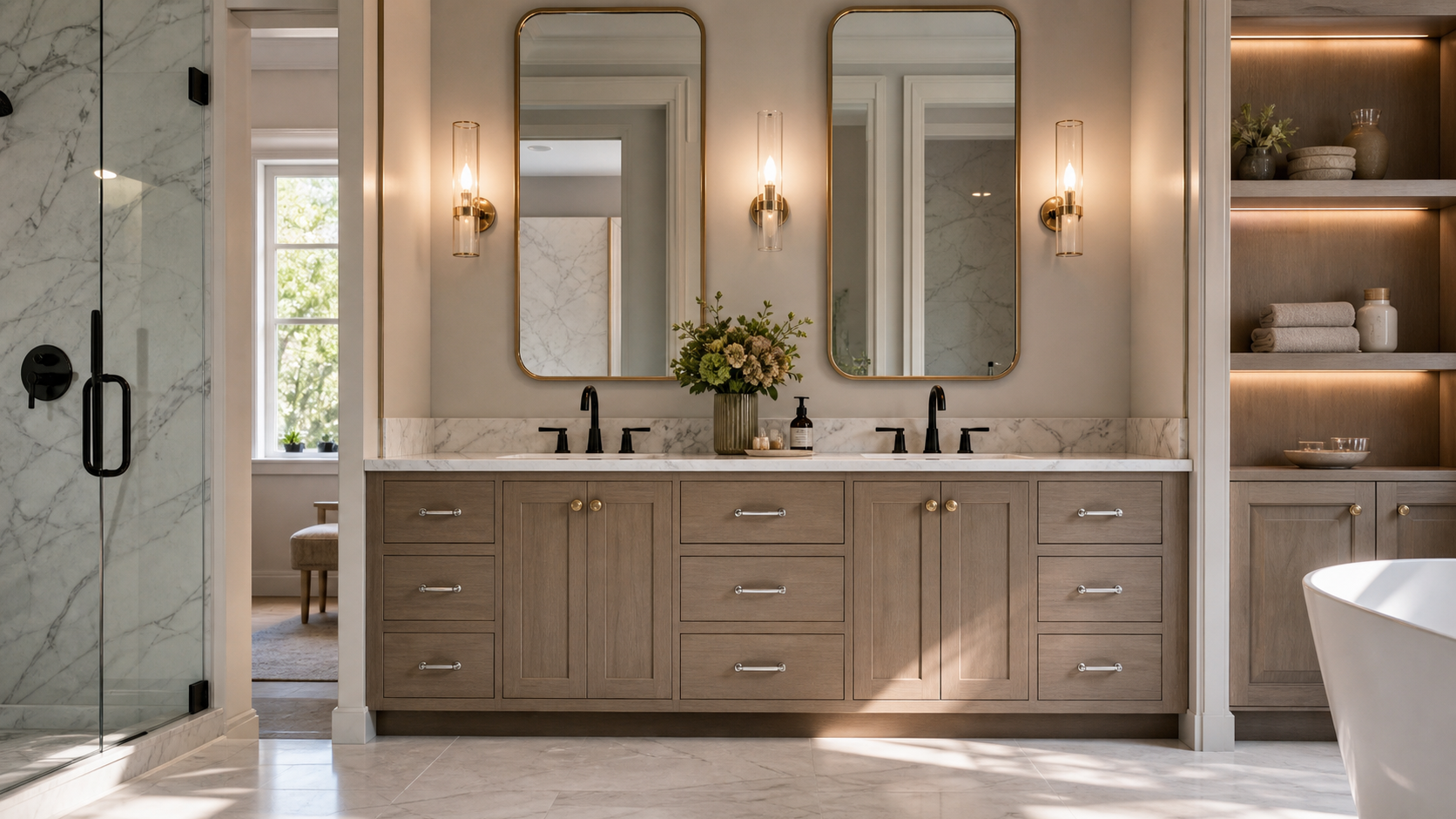
This comes up constantly. A homeowner is renovating the kitchen and choosing cabinet hardware. Then they’re selecting the bathroom vanity hardware. Then the door hinges. Then the plumbing fixtures. Then the light fixtures. At some point someone asks: should all of this match? What does “matching” even mean across an entire house?
The honest answer has a few parts. Let’s work through each one.
The case against matchy-matchy
A home where every metal is the exact same finish looks like it was purchased from a single manufacturer’s catalog in a single season. That’s not cohesion. Cohesion comes from a considered relationship between finishes, where you can see the decision-making, not from the absence of variation. Exact matching across a whole house tends to read as controlled rather than curated.
Think of how a well-dressed room works. The brass lamp, the matte-black drawer pull, and the nickel faucet in the same space don’t clash if the person who specified them understood the ratio and the relationship. The brass is dominant and warm. The black is grounding. The nickel adds lightness without competing. Each is doing a job, and together they feel considered.
The version that fails is when those three finishes arrived separately, without anyone thinking about the whole. The drawer pull was chosen for the kitchen. The faucet came with the vanity. The light fixture was on sale. The result is three metals that don’t fight exactly but don’t belong together either. They read as unconsidered.
How to build a metal palette that holds the house together
A workable house-wide metal palette typically has three tiers: a dominant finish that appears in the highest-visibility hardware (cabinetry, plumbing, light fixtures), a secondary finish that grounds or contrasts (often matte black or oil-rubbed bronze), and a tertiary finish used sparingly as an accent. All three should share a tonal family: warm metals tend to work together, cool metals together, and mixing warm and cool requires more care.
In practice, at Shea Studio, the metal conversation usually starts with the kitchen, because that’s where the most hardware lives and where the decisions are most visible. If brushed brass is the dominant metal in the kitchen, we want to see it recur in the primary bath, the powder room, and at least a few light fixtures throughout the home. Not identical pieces. The same finish, from related families.
The secondary finish might appear as matte black cabinet hardware in the pantry or laundry room, where you want a slightly harder edge. Or as oil-rubbed bronze on interior door hinges where the warm, darker tone bridges the warm brass and the cooler metals in some of the windows. Every appearance is a choice, not a default.
Does door hardware need to match cabinet hardware?
Not exactly, but they should share the same tonal family. Interior door hardware and cabinet hardware are read together when both appear in a space. The most common and workable approach is to use the same finish for both categories within a given room, with some latitude to vary between rooms if the variation is intentional. Door hardware that contrasts cabinet hardware in the same room usually reads as an oversight.
One place this comes up frequently in Northern Virginia homes: builder-grade brass door hardware left over from the original construction, combined with new nickel or black cabinet hardware from a renovation. The mismatch is jarring because both are present in the same visual field and the relationship was clearly not designed. If you’re renovating the kitchen, it’s worth deciding what happens to the nearby door hardware at the same time.
What about plumbing fixtures vs cabinet hardware?
Plumbing fixtures and cabinet hardware don’t need to match exactly, but they benefit from being in the same finish family within a bathroom or kitchen. In bathrooms especially, the faucet, towel bar, shower fixture, and cabinet hardware are all in close proximity and read as a set. Mixing warm and cool metals in a small space requires careful handling because the contrast is very visible.
A common approach we use in bathroom design: the faucet and towel hardware in brushed brass, the cabinet hardware in a related unlacquered brass, and a single dark element, such as a matte-black shower valve or mirror frame, as the grounding note. The variation is intentional and readable as such. What we avoid is a satin nickel faucet next to polished chrome towel bars next to brushed-gold cabinet pulls, which is three separate decisions made at three separate moments that happen to share a room.
| Finish pairing | Works together? | Notes |
|---|---|---|
| Brushed brass + unlacquered brass | Yes | Same family, different texture; warm and layered |
| Brushed brass + matte black | Yes | Classic warm/grounding contrast; ratio matters (brass dominant) |
| Satin nickel + brushed chrome | Yes | Cool tones, close relationship; subtle variation |
| Brushed brass + satin nickel | With care | Warm meets cool; works if one clearly leads |
| Polished chrome + oil-rubbed bronze | Difficult | Very different tone and sheen; requires strong design context |
| Four unrelated finishes in one room | No | Reads as accumulated, not designed |
Sorting out the metals for your renovation?
Shea Studio Interiors has been specifying finish palettes across Northern Virginia and Metro DC for 30+ years. We make these decisions as a system, not as separate choices. Let’s talk about what your project needs.
Frequently asked questions
Do light fixtures need to match cabinet and door hardware?
They should be related. A light fixture finish that sits well within your established metal palette, even if it’s not an exact match, will read as intentional. A light fixture in a finish that came from a different palette entirely will read as an afterthought. In an open plan where kitchen hardware and dining pendants are in the same visual field, the relationship matters even more.
Can I mix warm and cool metals in the same room?
Yes, with care. The key is that one finish leads clearly and the other is used in a supporting role. A room where warm brass is dominant and brushed nickel appears only on one element reads as layered. A room where warm brass and cool nickel compete equally reads as unresolved. Contrast is a design tool. Equal competition is not.
Should all the light fixtures in my home be the same metal?
Not necessarily, but the finish family should carry through. If brass is your dominant metal throughout, light fixtures in brass or brass-adjacent finishes, from polished to antique to brushed, will feel like they belong to the same home. A single chrome fixture in an otherwise all-warm-metal home will feel like it arrived from somewhere else.
What’s the most versatile metal finish for a whole house?
Brushed or satin brass is one of the most consistently well-regarded choices for whole-home cohesion, particularly in warmer interiors with natural wood tones. It pairs well with most cabinet colors, stone countertops, and soft goods. Brushed nickel performs similarly in cooler interiors. Matte black works as a strong secondary finish in either direction. These aren’t fashion choices. They’re combinations that have held up across decades of residential use.
Does every room need to share the same metal finish?
Not every room needs to be identical, but there should be a thread. The powder room can be a moment, with a finish that differs from the rest of the house, if that contrast is deliberate and the rest of the home is consistent. What you’re trying to avoid is each room making its own unrelated metal decision, which produces a home that feels like a series of separate projects rather than one designed whole.
What if I already have mismatched metals throughout my house?
Start by identifying what you have. Then decide: which finish do you love most and want to lead? Change the outliers to align with that finish, starting with the most visible hardware. Cabinet pulls are often the highest-impact, easiest-to-swap item. Door hardware is next. Over time, as fixtures get replaced, steer them toward the palette you’ve decided on. It doesn’t have to happen all at once.
or call 703-891-1570