
Flooring · Northern Virginia
Hardwood vs. Engineered Wood Flooring: Which Is Right for Your Home?
Solid hardwood offers the deepest refinishing potential and a true wood surface throughout, but cannot go below grade or over radiant heat. Engineered wood handles humidity swings, basements, and radiant systems that solid hardwood cannot. Choose engineered for anywhere humidity fluctuates or the slab is on or below grade; choose solid hardwood for main-floor rooms with stable climate control.
What is the structural difference between the two?
Solid hardwood is a single piece of wood milled to 3/4-inch thickness. Engineered wood is a layered construction: a real hardwood veneer bonded to a cross-ply plywood or HDF core. The veneer is genuine wood; the construction underneath it is what changes how the product performs under moisture and temperature shifts.
The cross-ply construction of engineered flooring is the key. Each layer is oriented perpendicular to the one beneath it, which restricts the wood’s natural tendency to expand and contract across the grain. Solid hardwood expands and contracts freely across its full 3/4-inch thickness, which is why it cannot be installed below grade (moisture migrates up through concrete slabs) and why it requires an acclimation period before installation in Northern Virginia homes, where summer humidity regularly reaches 60 to 80 percent.
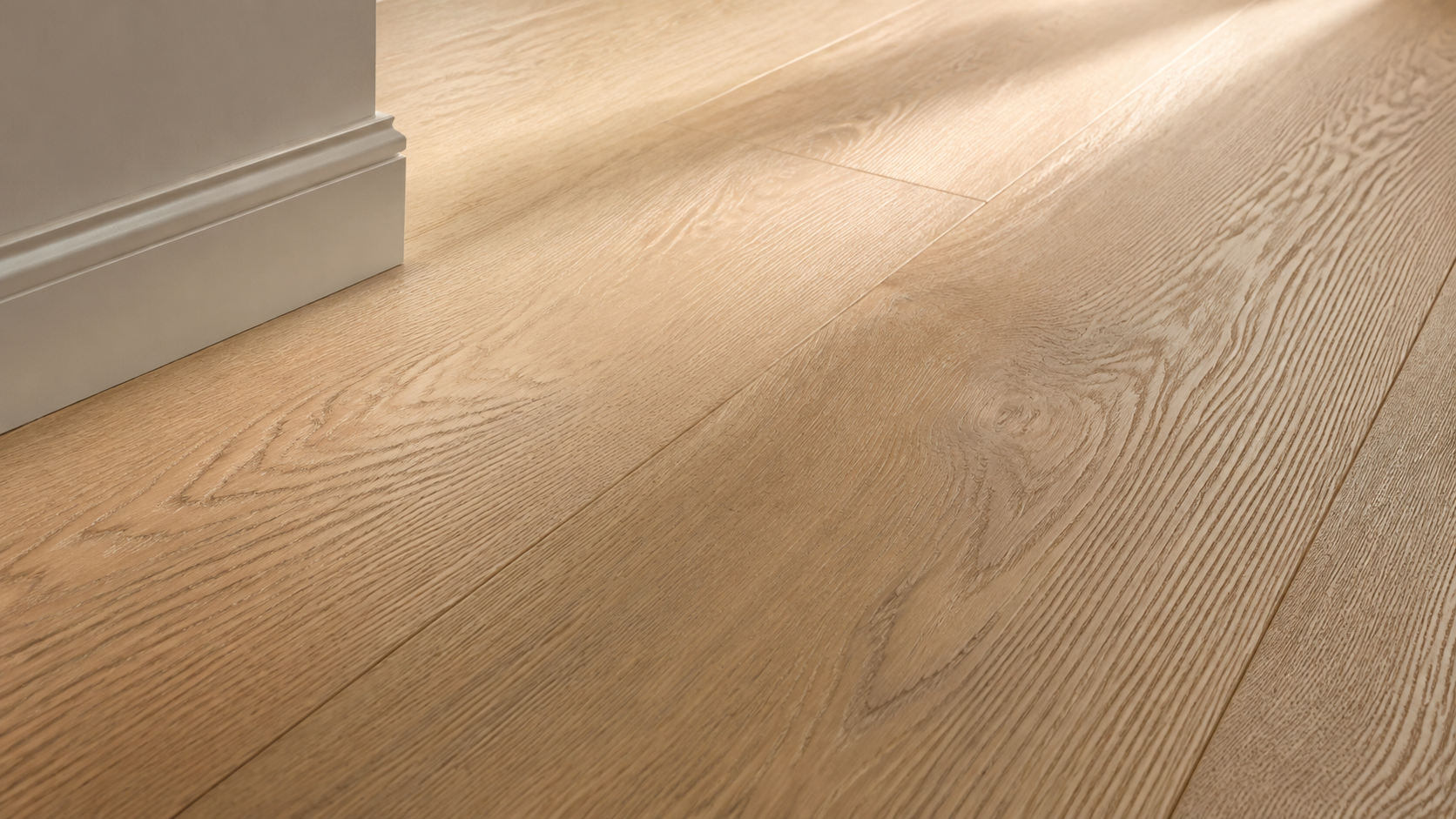
The veneer layer in engineered wood is the same species and grain you are selecting. A white oak engineered floor looks identical to a solid white oak floor at face level. The difference is invisible unless you cut through the board or look at the tongue-and-groove profile from the side.
Where can each type be installed?
| Installation location | Solid hardwood | Engineered wood |
|---|---|---|
| Above grade (main floor, second floor) | Yes | Yes |
| On grade (slab-on-grade first floor) | Not recommended | Yes, with moisture barrier |
| Below grade (basement) | No | Yes, with proper vapor control |
| Over radiant heat | No (warping risk) | Yes (species/thickness dependent) |
| High-humidity spaces (sun rooms) | Risky | Better suited |
| Direct glue-down to concrete | Limited; requires floating or nailing to sleepers | Yes, most products allow glue-down |
How many times can each be refinished?
Solid hardwood at 3/4-inch thickness can typically be sanded and refinished seven to nine times over its lifetime, which translates to 80 to 100 years of service with proper care. Engineered wood’s refinishability depends entirely on veneer thickness: a 2mm veneer allows one light sand and recoat; a 6mm veneer allows three to five full refinishes.
The veneer thickness specification matters more than any other number when evaluating engineered flooring. Budget-tier engineered products sold in big-box stores frequently carry 1 to 2mm veneers that cannot be refinished at all without sanding through to the core. These products look identical to premium products in the store. You discover the difference at year 15 when you want to refresh a scratched floor and your flooring contractor tells you the veneer is too thin to sand.
At Shea Studio we specify engineered products with a minimum 4mm veneer for any client who plans to stay in a home long-term. At 4mm you get two full refinishes and one light screen-and-recoat, which covers most Northern Virginia families through two to three decades of normal use.
Species: which wood holds up best?
Janka hardness is the industry standard for comparing wood species’ resistance to denting and scratching. White oak (1360 Janka) and hickory (1820 Janka) are common in Northern Virginia homes for their durability. Walnut (1010 Janka) and maple (1450 Janka) are also popular but each has trade-offs in dent resistance and color consistency.
White oak has become the dominant choice across Northern Virginia renovations over the past several years, and the reasons are functional rather than purely aesthetic. It is harder than red oak (the previous standard), accepts both warm and cool finish tones, and its open grain takes wire-brushed or hand-scraped textures that hide daily scratches and pet marks better than a smooth, glossy finish.
Walnut’s lower Janka rating means it dents more easily, which reads as “character” in some homes and as “damage” in others. Its rich chocolate tones are visually stunning but limit flexibility when you want to change furniture or paint colors later. See our guide on how to mix wood tones for guidance on working walnut into a room that already has lighter wood elements.
Maple is very hard and takes stain unevenly, which means factory-finished maple in a consistent color tone is often the right approach rather than site-finishing. Its tight, light grain makes a room feel clean and contemporary but shows scratches more on a high-gloss finish.
Finish choices and how they affect daily maintenance
Matte and satin finishes hide dust, pet hair, and fine scratches better than semi-gloss or high-gloss. Wire-brushed or hand-scraped textures do the same by breaking up light reflection. Oil-modified finishes are more forgiving of wear and easier to spot-repair than water-based polyurethane, which requires full-floor recoating when damaged.
The finish sheen level is the most noticeable maintenance variable in day-to-day life. A high-gloss floor in a household with children, dogs, or high foot traffic shows every footprint, every piece of tracked grit, and every minor abrasion immediately. The floor does not wear faster, but the visible wear register is much higher. A matte finish on the same species and installation hides the same level of use behind its light-diffusing surface.
Oil-modified urethane sits deeper in the wood grain and can be refreshed with a maintenance coat without screening the entire floor. Water-based polyurethane cures harder and clearer but sits more on the surface. When a localized area is damaged, water-based finishes often require full sanding and recoating because the patch is visible at any angle. The right finish choice depends on the household’s tolerance for maintenance versus its tolerance for visible wear. See our guide on where to splurge and where to save in home design for how flooring fits into a broader project budget strategy.
What does flooring cost in Northern Virginia?
Installed hardwood flooring in the Northern Virginia and Metro DC market runs $8 to $14 per square foot for quality solid hardwood and $7 to $12 per square foot for quality engineered. Budget-tier engineered runs $4 to $6 installed but often carries veneers too thin to refinish. Premium wide-plank or custom-milled products run $18 to $30 installed.
The installation cost component is significant: labor in Northern Virginia averages $3 to $5 per square foot for a standard straight installation. Diagonal or herringbone patterns add $1.50 to $3 per square foot in labor. Stair nosings, transitions, and floor leveling are separate line items that add meaningful cost on jobs with existing floor height mismatches.
Material ordering requires a 7 to 10 percent waste factor for standard installations and 12 to 15 percent for diagonal or herringbone patterns. Order once, correctly: flooring from the same manufacturing lot matches in color; a second order from a different lot may not. We track lot numbers for every flooring project to ensure continuity if a repair piece is ever needed.
Flooring questions for your renovation?
Shea Studio Interiors has specified and sourced flooring for Northern Virginia and Metro DC homes for more than 30 years. We coordinate material selection with the full interior palette so every surface works together.
Frequently asked questions
Can engineered hardwood look as good as solid hardwood?
Yes. The face veneer of engineered hardwood is the same genuine wood species as solid hardwood, cut from the same logs and finished the same way. At face level, a high-quality engineered floor with a thick veneer is visually indistinguishable from solid hardwood. The difference is structural, not aesthetic.
Is engineered wood waterproof?
Engineered wood is moisture-resistant, not waterproof. It tolerates humidity swings and occasional surface moisture better than solid hardwood, but standing water left for extended periods will damage any wood floor. In wet areas like bathrooms and laundry rooms, porcelain or luxury vinyl is the appropriate flooring choice.
How long does hardwood flooring last?
Solid hardwood with a 3/4-inch thickness can last 80 to 100 years with periodic refinishing. Engineered hardwood with a quality 4mm or thicker veneer lasts 25 to 50 years with one to three refinishes depending on veneer depth. Budget engineered products with veneers under 2mm may not be refinishable at all and have a practical lifespan of 15 to 20 years.
What is the best hardwood floor species for a household with dogs?
White oak and hickory offer the best combination of hardness and appearance for homes with dogs. A wire-brushed or hand-scraped texture finish in a matte or satin sheen hides claw marks and small scratches far better than a smooth, high-gloss surface. Avoid walnut, which dents more easily, and maple in high-gloss, which shows every scratch immediately.
Can I install hardwood floors over radiant heat?
Engineered hardwood is generally compatible with radiant heat systems when the floor surface temperature does not exceed 80 degrees Fahrenheit and humidity is maintained between 35 and 55 percent. Solid hardwood is not recommended over radiant heat because expansion and contraction cycles under the planks cause gapping and cupping. Confirm the specific product’s radiant heat rating before purchase.
How long does hardwood floor installation take?
Acclimation of solid hardwood before installation takes three to seven days in a climate-controlled environment. Installation itself runs one to three days for a typical room depending on square footage and pattern complexity. Site-finished floors (sanded and finished after installation) require an additional two to three days for sanding, staining, and finish coats, plus 24 to 48 hours of dry time before light foot traffic.