
Kitchen Design · Northern Virginia
How to Choose Cabinet Hardware for Your Kitchen or Bathroom
Cabinet hardware is the jewelry of a kitchen or bathroom, and it’s one of the last decisions you make and one of the most visible. Choose your dominant metal finish first, keep the scale proportional to the cabinet size, and pull the hardware profile from the room’s overall style. A 5-inch pull on a 24-inch cabinet reads as too small.
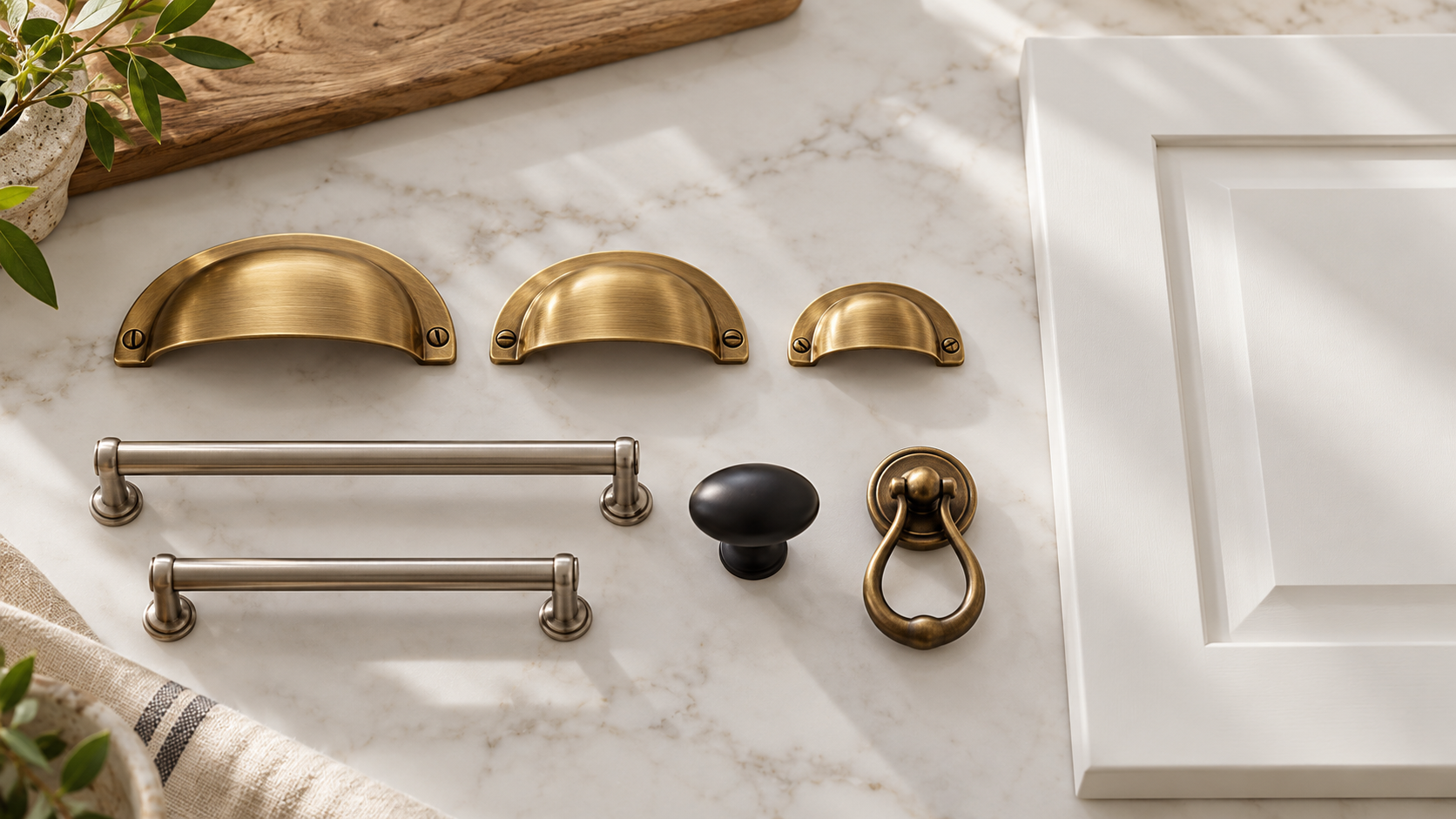
Cabinet hardware is one of those decisions that feels small until you get it wrong. A pull that’s too delicate looks lost on a big drawer face. A finish that clashes with the faucet makes the whole kitchen look unresolved. And yet the process of choosing hardware is straightforward when you work through it in the right order: finish first, scale second, profile third.
We work through this sequence with every kitchen and bathroom client, from full renovations in McLean to cabinetry refreshes in Fairfax County. This guide covers the decisions that matter and the order to make them.
Pulls vs. knobs: which do you actually need?
Use knobs on cabinet doors and pulls on drawers. Knobs offer a single point of contact, which works well for doors. Pulls give you the span needed to open wider or heavier drawers without putting torque on the box. If you want a cleaner look, pulls on both doors and drawers is a solid approach.
Knobs work well on cabinet doors because you’re making a single pulling motion with one hand. They’re compact, so they don’t compete with tile, wood grain, or a detailed door profile. Knobs read traditional to transitional when rounded and more contemporary when cylindrical or square in shape.
Pulls belong on drawers. A drawer is heavier and wider than a door, and you want the leverage that a bar pull provides. On a standard 18-inch drawer, a 3-inch pull is a minimum. On a large pot drawer or spice drawer spanning 24 to 30 inches, 5 to 6 inches is the better choice. A single knob centered on a big drawer front looks visually off-balance and is genuinely harder to open.
Can you use pulls on doors instead of knobs? Absolutely, and we do it often. Pulls on both doors and drawers is a cleaner look that works especially well in contemporary and transitional kitchens. The key is to keep the same finish across both so the room reads as one decision rather than two.
What tends to fall flat is mixing knobs on both doors and drawers. A single knob in the center of a 30-inch drawer face lacks the leverage and visual proportion the piece needs. If you prefer knobs on your upper door fronts, pair them with a matching-finish drawer pull rather than scaling the knob up.
Choosing a finish that works with the room
Finish choice drives the room’s entire metal story. Make this decision at the same time you select your faucet and lighting, not separately. Choose one dominant finish that runs through 70 to 80 percent of the metal in the room. Let one secondary finish appear in a few supporting places.
The finish you choose for cabinet hardware should lead the rest of the metal story in the kitchen or bathroom. When hardware, faucet, and light fixtures share a finish family, the room reads as cohesive. When they don’t, the mismatches are what people notice first, even if they can’t say exactly why.
| Finish | Tone | Pairs well with | Watch out for |
|---|---|---|---|
| Brushed brass / satin brass | Warm, muted | White, navy, sage, natural wood | Not all “brass” reads the same; compare samples |
| Unlacquered brass | Warm, living finish | Traditional and eclectic spaces | It patinas over time; some love it, others don’t |
| Champagne bronze | Warm, neutral | Wood tones, warm whites, taupe | A useful middle ground between brass and nickel |
| Brushed nickel | Cool, soft | Gray, crisp white, two-tone cabinets | Can feel dated next to polished chrome; pick one |
| Polished chrome | Cool, bright | Modern and transitional kitchens | Shows fingerprints more than matte finishes |
| Matte black | Neutral-dark | White, gray, greige, wood tone | Commit to it through faucets and lighting too |
| Oil-rubbed bronze | Warm, dark | Cream, warm white, rich wood tones | Can feel heavy in smaller spaces |
Our working rule: if your cabinets or countertops carry warm tones, lean warm in the hardware finish. Cool or bright white cabinets pair cleanly with matte black or brushed nickel. Gray cabinetry can go either direction, but committing to one family reads sharper than mixing warm and cool across the same run of cabinets.
For a deeper look at coordinating finishes across the whole room, see our guide on how to mix metals in a room and our specific page on whether hardware and metals need to match.
Getting the scale proportional to the cabinet
Hardware that’s too small disappears. Hardware that’s too large overwhelms the cabinet face. Measure the drawer or door width before ordering, and use a size ratio as a guide: the pull length should span roughly 20 to 30 percent of the drawer width. On a 24-inch drawer, that’s a 5 to 7-inch pull.
Scale is where we see the most common mistakes, and it’s where the most common “something feels off” reactions come from. Here are the sizing rules we use in Northern Virginia kitchen projects:
- Upper cabinet doors (12 to 18 inches wide): knob 1.25 to 1.5 inches in diameter, or a 3-inch bar pull
- Lower cabinet doors: a 3 to 4-inch pull, or a 1.25-inch knob placed at a comfortable height
- Standard drawer fronts under 18 inches: 3-inch pull, measured center-to-center
- Drawer fronts 18 to 24 inches: 3.75 to 5-inch pull
- Drawer fronts 24 to 36 inches: 5 to 6.25-inch pull
- Large pot drawers and appliance garages: 6 to 10-inch pull
- Full-height pantry doors or refrigerator panels: 12-inch or longer bar pull
The measurement that matters when ordering is the center-to-center distance, which is the span between the two mounting holes. Most pulls come in 3-inch, 3.75-inch, 5-inch, 6.25-inch, and 8-inch center-to-center sizes. This is different from the overall pull length, which includes the end caps beyond the holes. When you’re comparing options, compare center-to-center measurements, not overall length.
Door profile and the hardware that fits it
The style of the cabinet door shapes what hardware looks natural on it. Shaker doors are the most versatile and work with almost any profile. Flat-front (slab) doors suit architectural bar or edge pulls. Inset cabinets with visible frames tend to read best with smaller, more refined hardware.
Shaker cabinets are the most forgiving door profile when it comes to hardware selection. The clean rail-and-stile frame actually shows hardware nicely because the geometry doesn’t compete. Cup pulls, cylindrical bar pulls, and simple bin pulls all look at home on a shaker door. Right now in Northern Virginia kitchens, we’re seeing a lot of brushed brass and matte black bar pulls on white and two-tone shaker cabinetry.
Flat-front (slab) cabinets suit hardware that shares the same clean, architectural character. Bar pulls, integrated pulls, and edge pulls all read correctly. Decorative knobs with ornamental shapes can feel like a design conflict on a slab door because the door’s minimalism and the hardware’s ornament don’t share a visual language.
Inset cabinets have doors that sit flush inside the face frame rather than overlaying it. Because the frame itself is a visible design element, hardware placement has to be more precise, and smaller, more refined pieces tend to read more elegantly. Cup pulls and bin pulls are traditional choices for inset work. Larger bar pulls can look proportionally heavy against the frame.
Beadboard and raised-panel doors already carry decorative detail. Hardware with a little curve or decorative character fits well here, and smaller knobs read appropriately. Very spare modern pulls can feel like a mismatch against detailed door profiles.
Mixing hardware across perimeter and island
You can use different hardware profiles on the island versus the perimeter cabinets. Keep the same metal finish across both zones and vary only the profile. For example, cup pulls on the perimeter drawers and a long bar pull on the island panel face. Mixing finishes across zones usually reads as unresolved unless both finishes also appear together elsewhere in the room.
This is one of the most common questions we hear. Kitchen islands often have different drawer and door configurations than the perimeter run, and the island face panels are usually wider, so it makes sense to consider different hardware there.
The rule that holds: same finish, different profile is intentional. Different finish across different zones is a problem. Brushed brass on the perimeter cabinets and matte black on the island reads as two separate design decisions rather than one cohesive kitchen, unless those two finishes are also woven together elsewhere in the room through the faucet, the light fixtures, or other details.
A use of two finishes that does work: running the dominant hardware finish on all doors and drawers, then using a second accent finish on just the interior knobs of glass-front upper cabinets. Because those knobs are a secondary detail rather than the primary hardware, the second finish reads as a purposeful moment rather than a contradiction.
For detailed guidance on this, see our backsplash and cabinet pairing guide, which covers how all the visual elements in a kitchen should relate to each other.
Hardware, faucets, and lighting: the full picture
Cabinet hardware doesn’t live alone. It lives alongside the faucet, the range hood, the light fixtures, and the appliances. These should tell one coherent metal story. Choose one dominant finish and let it run through 70 to 80 percent of the metal in the room. Use a second finish in two or three supporting places, not scattered throughout.
The clearest approach is to pick one finish and let it lead. Cabinet hardware, faucet, light fixture hardware, and range hood finish all in the same family. Let the appliances (usually stainless steel or matte black) play the supporting role.
When clients want to mix metals intentionally, which is a perfectly valid choice, we follow the dominant-secondary-accent framework. The dominant finish appears on most of the metal in the room. The secondary finish shows up in two or three places. The accent is a moment or two at most. A kitchen where brushed brass hardware leads, a brushed brass or champagne bronze faucet supports it, and a gold-toned pendant light or two appears over the island reads cohesive because the warmth of the finish family runs through the space.
What doesn’t work is a clearly warm hardware finish paired with a clearly cool faucet when neither appears anywhere else in the room. The mismatch is isolated to the sink area and reads as an oversight rather than a choice. If you’re working through this question now, our guide on whether hardware and metals should match covers the full framework.
Want to get your hardware exactly right?
Hardware seems like a small decision, but it’s one of the most visible in the finished kitchen or bathroom. Our team helps Northern Virginia homeowners make choices that bring the whole room together. Let’s talk through your project.
Frequently asked questions
Should cabinet pulls and knobs match exactly?
They don’t need to be an identical match, but they should belong to the same finish family. Brushed brass pulls on drawers and brushed brass knobs on doors will look cohesive. You can vary the profile (a cup pull on drawers with a cylindrical knob on doors) as long as the finish is consistent. What creates visual noise is two clearly different finishes, like polished chrome knobs with matte black pulls, without a design reason for the contrast.
What size pull works on a 24-inch drawer front?
For a 24-inch drawer front, a 5-inch pull (measured center-to-center between the mounting holes) is a solid starting point. Some designers prefer 6.25 inches on this size for more visual weight. A 3-inch pull on a 24-inch drawer will look undersized. The general proportion guideline is that the pull should span roughly 20 to 25 percent of the drawer width, which puts you between 5 and 6 inches on a 24-inch front.
Is brass hardware still a good choice?
Yes. Brass has had a strong resurgence in interior design and it’s holding its place. The key difference from earlier brass trends is the finish: most current brass hardware comes in brushed, satin, or unlacquered versions rather than high-polished or lacquered options. These matte finishes read warm and current rather than dated. Brushed brass and champagne bronze work especially well with white, cream, navy, and natural wood cabinetry.
Can I use different hardware on the island than the perimeter?
Yes, and it can look purposeful when done correctly. The most reliable approach is to keep the same metal finish across both and vary only the profile. For example, cup pulls on perimeter drawers and a long bar pull on the island side panels. What tends to read as unresolved is mixing finishes between zones, such as brushed nickel on the perimeter and matte black on the island, unless both finishes also appear together in the room elsewhere.
What’s the difference between a cup pull and a bar pull?
A cup pull (also called a bin pull) is a half-round or U-shaped pull mounted flush to the cabinet face, with the fingers wrapping underneath the cup to open. It has a traditional character and originated in furniture-making. A bar pull is a cylindrical or rectangular rod mounted on two posts. It reads cleaner and more contemporary. Cup pulls suit shaker, inset, and furniture-style cabinetry. Bar pulls are at home on shaker, flat-front, and more modern cabinetry. Both are practical; the choice is primarily visual.
Should cabinet hardware match the faucet?
They should belong to the same metal family, though an exact match isn’t required. A brushed brass cabinet pull and an unlacquered brass faucet can read intentional because both carry warm tones in a similar range. What’s harder to make work is a clearly warm hardware finish paired with a clearly cool faucet when no other element in the room bridges the two. If you want to mix metal families, both finishes should appear more than once across the space rather than each appearing only in one spot.