
Space planning · Northern Virginia
Area Rug Size Guide: What Size Rug Do You Actually Need?
The most common rug mistake is choosing one that’s too small. In a living room, all four furniture legs should sit on the rug, or at minimum the front two legs of each piece. In a dining room, the rug should extend 24 inches past all four sides of the table when chairs are pushed in. In a bedroom, the rug should extend 18 to 24 inches past the foot and both sides of the bed. When in doubt, go one standard size up.
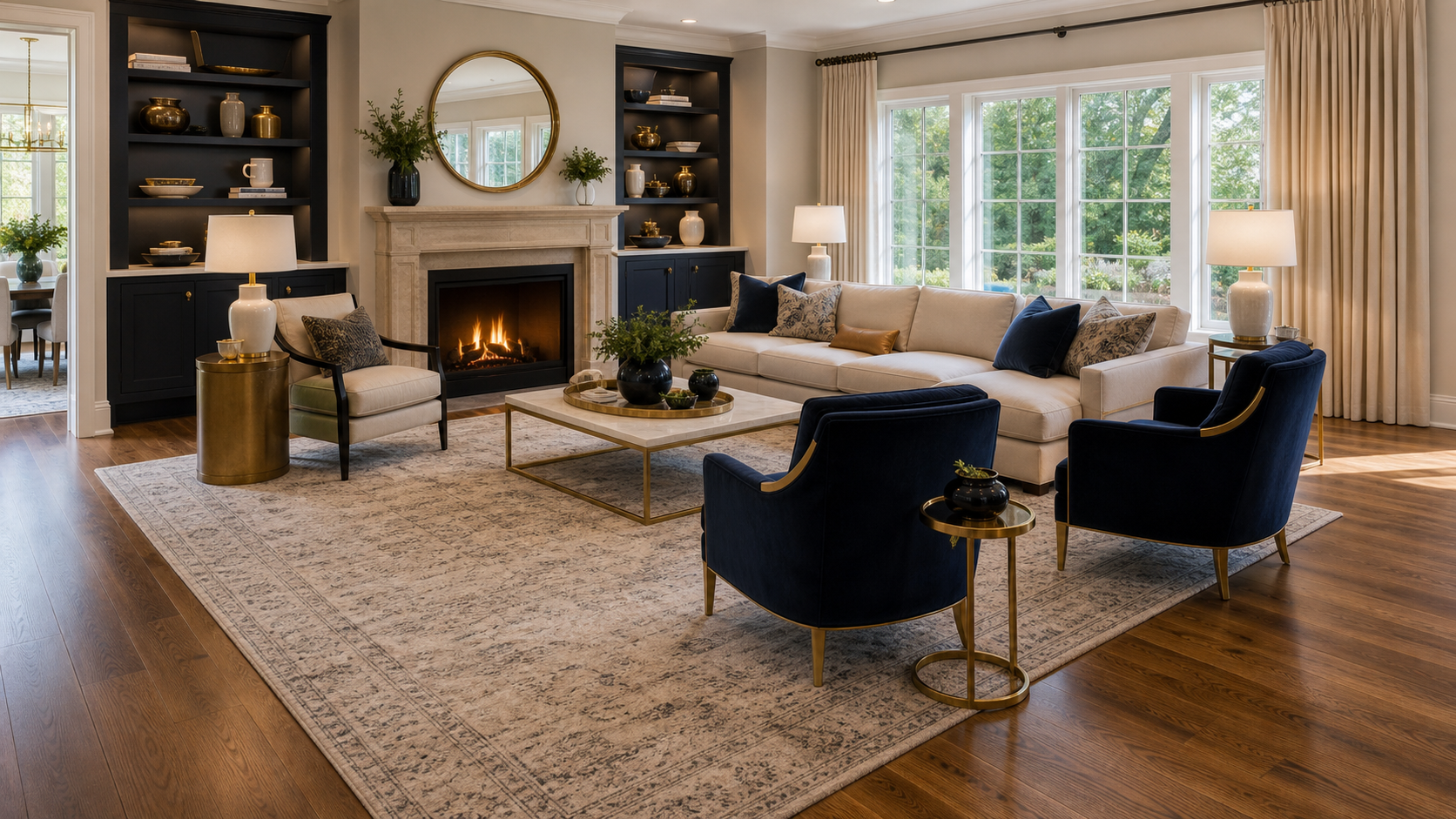
Rugs seem like the easy part of a room. You find a pattern you like, pick a size from the available options, and order it. The problem is that rug vendors measure by what they make, not by what your room needs. A 5×8 is sold everywhere. In most living rooms, it looks like a bath mat that got lost. Here’s how to size correctly for every room type, and how to test your choice before you spend the money.
Living room rug sizing
For a living room, the rug should anchor the entire seating group. The preferred arrangement: all four legs of every piece of upholstered furniture sit on the rug. The acceptable minimum: the front two legs of the sofa and chairs sit on the rug, with back legs on the hardwood. Both arrangements work; the all-legs version reads as more finished and anchored.
In a standard Northern Virginia great room or living area with a sofa, two chairs, and a coffee table, a 9×12 rug is typically the minimum that allows all front legs to land on the rug. Many McLean and Great Falls living rooms with generous seating arrangements need a 10×14. The single most common error is ordering an 8×10 because it’s the popular size in the store, then finding that no furniture legs actually reach the rug and it floats in the middle of the room like an island, a mistake that also makes a small room feel even smaller.
To test before ordering: lay out the dimensions in painter’s tape on your floor. Put your current furniture in place, or measure where you plan to put it. If the tape boundary falls inside the seating group on any side, the rug is too small. Err on the side of too large. A rug that’s slightly too big for the room creates a comfortable, wall-to-wall feel. A rug that’s too small for the furniture arrangement makes the entire room feel smaller and unanchored, which matters most when you’re planning a living room seating layout around a fireplace and TV.
Dining room rug sizing
The dining room rule is straightforward: the rug should extend at least 24 inches past the table on all four sides when the chairs are pushed in. That clearance gives a chair enough room to be pulled out and sat in without the back legs scooting off the rug onto the hard floor. If the rug is smaller, chairs will constantly catch on the edge. This typically means a 9×12 for a six-person table and a 10×14 for an eight- to ten-person table.
A rectangle table takes a rectangle rug; a round table can take either a round or a rectangle rug. For a round table, a round rug looks cohesive: size it so it extends 24 inches past the table’s edge. If you prefer a rectangle, size it as if the table were the same length on each side. For an oval table, a rectangle rug sized 24 inches larger than the table’s longest and shortest dimensions works well.
One mistake to watch: ordering the rug before finalizing the table. If you’re renovating and the table size is still in flux, hold the rug order. A rug that was right for a 72-inch table is usually wrong for a 96-inch table that replaces it. Commit to your table dimensions first, measure the clearance on all four sides, and then order the rug.
Bedroom rug sizing
In a bedroom, the rug should extend 18 to 24 inches past the foot of the bed and past both sides of the bed. This ensures that the first foot that hits the floor in the morning lands on the rug, not on cold hardwood. It also ensures the rug is visible on each side of the bed, framing it properly. For a king bed with nightstands, a 9×12 or 10×14 is the typical correct size.
The placement options for a bedroom rug: the rug goes under roughly two-thirds of the bed, starting from the foot, extending past both sides. The headboard sits behind the rug’s far edge. This is the standard. The alternative is placing only the foot portion of the rug under the bed, with the rug starting at the foot and running into the room. Both work; the first reads as more luxurious.
One exception: a rug that runs the full length under the bed and nightstands creates a floating, platform-bed effect that many luxury Northern Virginia bedrooms use. For this look, the rug must extend at least 12 inches beyond the nightstands on each side and at least 18 inches past the foot. This usually requires a 10×14 or larger for a king-size bed with proper nightstands.
Room-by-room quick reference
| Room | Furniture arrangement | Rug should extend | Typical minimum size |
|---|---|---|---|
| Living room | Sofa + 2 chairs + coffee table | Under all front legs of all seating | 9×12 |
| Living room (large) | Sectional or larger seating | Under all front legs of all seating | 10×14 |
| Dining room (6-person table) | Rectangle or round table | 24″ past table edge on all sides | 9×12 |
| Dining room (8-10 person table) | Larger table | 24″ past table edge on all sides | 10×14 |
| Bedroom (queen) | Queen bed + 2 nightstands | 18-24″ past foot and both sides | 8×10 |
| Bedroom (king) | King bed + 2 nightstands | 18-24″ past foot and both sides | 9×12 or 10×14 |
How to test before you buy
Mark your rug’s proposed dimensions in painter’s tape on the floor. Place your furniture in position. If any furniture legs fall outside the tape boundary, the rug is too small. If the tape runs edge-to-edge across the whole room with less than 18 inches of floor showing, the rug might be too large. Between 12 and 24 inches of floor showing around the rug’s perimeter is the ideal target in most rooms.
This painter’s tape test takes 20 minutes and saves hundreds of dollars. Run it every time, for every room, before placing an order. Rug returns are expensive and time-consuming; shipping large rugs across the country and back is often the customer’s cost. The tape test is the single best investment of your time in the rug selection process.
A note on scale: a well-placed rug also interrupts a wood dining table sitting directly on wood floors, which is one of the quiet tricks in mixing wood tones without clashing. You can make a rug work in a room where the ideal size isn’t available in the pattern you love by adjusting furniture placement. Pulling furniture slightly away from the walls and closer together can bring a 9×12 into correct proportion for a room that might theoretically need a 10×14. The rug sizes the conversation group, not the room. Position the group to fit the rug you have, rather than always chasing the next size up. Getting every element in proportion this way is what makes a whole home feel cohesive, and it is a detail our full-service design team handles on every project.
Every detail in proportion
Shea Studio Interiors plans furniture layouts and rug sizing for Northern Virginia and Metro DC homes as part of every full-service project. Thirty-plus years of making spaces work and look right, every time.
Frequently asked questions
What is the most common rug sizing mistake?
Choosing a rug that’s too small. A 5×8 in a living room with a full sofa and chairs leaves the rug stranded in the middle of the seating arrangement with no furniture anchoring it. The rug looks like an afterthought rather than a foundation. When in doubt, size up. A room can handle a slightly large rug far better than a too-small one.
What size rug fits under a sectional sofa?
Sectionals need large rugs, often 10×14 or larger, because the sectional itself covers a lot of floor space. The rug should fit under the front two legs of all sections of the sofa and extend far enough that the coffee table and any accent chairs also have their front legs on the rug. Measure the full L-shape footprint of the sectional before choosing.
Can a rug be too large for a room?
In practice, rarely. Leaving 12 to 24 inches of floor visible around the rug’s perimeter is the general target. Below 12 inches, the rug starts to feel like wall-to-wall carpet and loses its framing power. But a rug that’s slightly too large is almost always a better outcome than one that’s too small. Too-large rugs make a room feel grounded and generous; too-small rugs make it feel unresolved.
What if my room is an unusual shape?
Focus the rug on the primary furniture arrangement rather than the room’s shape. A long, narrow room with a square conversation group at one end can use a square or round rug sized to the furniture group, leaving the rest of the room open. The rug’s job is to anchor the seating, not to fill the floor. Painter’s tape is especially useful in oddly shaped rooms.
Should I layer rugs, and does that change sizing?
Layering is a valid design technique: a jute or sisal base rug in the correct size for the room, with a smaller patterned or softer rug layered on top under the coffee table. When layering, the base rug follows normal sizing rules. The top rug should be large enough to fit under the coffee table and extend 12 to 18 inches past it on all sides. The base rug is the anchor; the top rug is the accent.
What if a standard rug size doesn’t fit my layout?
Custom-size rugs are available from most quality rug vendors, typically with a 4 to 8-week lead time. If a standard 9×12 is too narrow for your room but a 10×14 is too large, a custom 9×13 or 10×12 may be the right answer. For a renovation or new build, it’s worth ordering custom if the investment in the rug justifies it. Getting the scale right matters more than staying within standard dimensions.
or call 703-891-1570