
Space planning & proportion · Northern Virginia
How to Make a Room with High Ceilings Feel Cozy
Rooms with high ceilings feel cold and cavernous when the design elements fight the height instead of working with it. The fix is to draw the eye downward and inward: hang art and drapery panels at the proper human-scale height rather than chasing the ceiling, layer multiple light sources that illuminate the lower half of the room, and use furniture and rugs with enough visual weight to anchor the space. The ceiling height becomes an asset, not a problem, once the lived-in zone is defined and the upper volume is treated as backdrop.
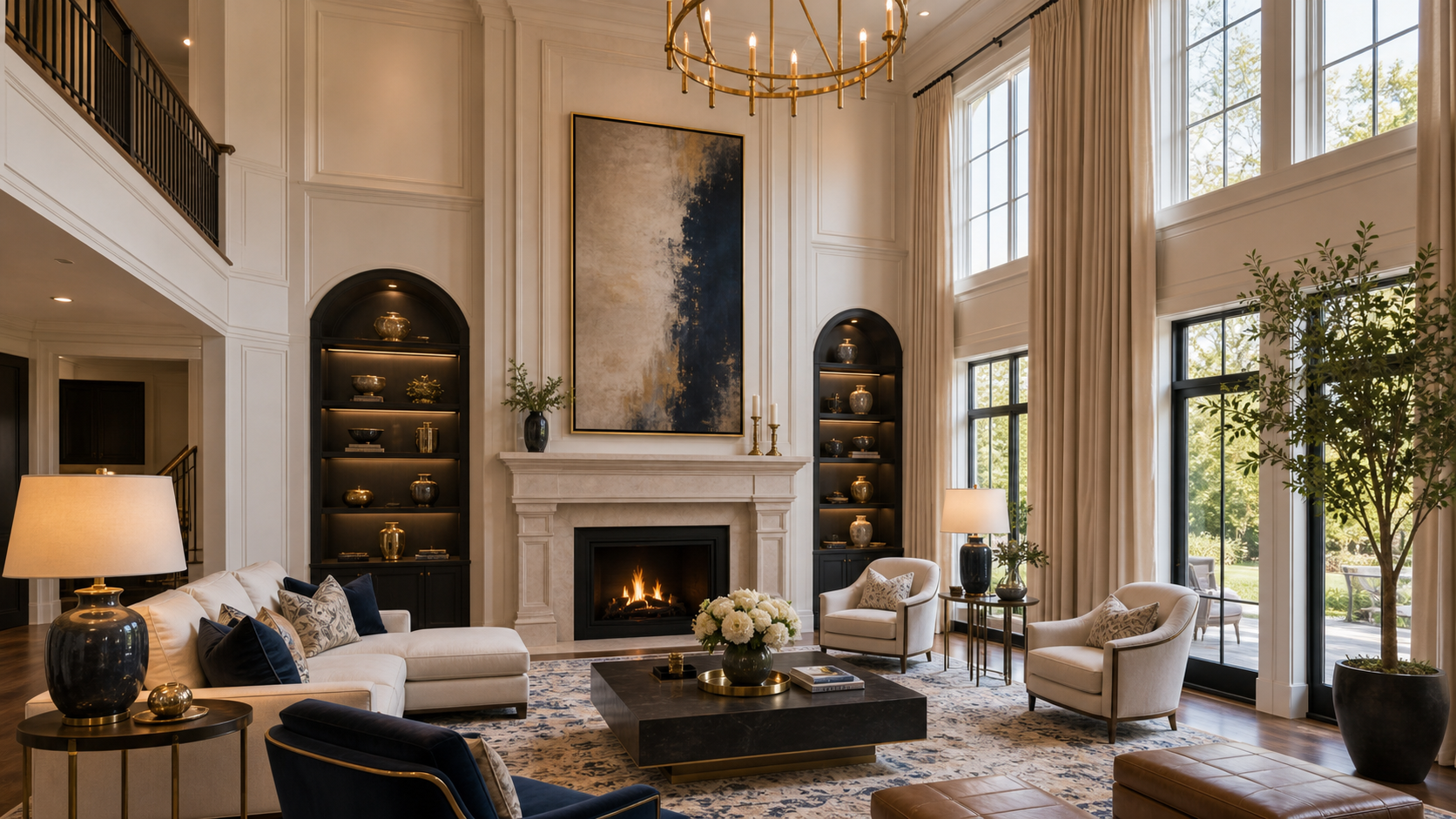
Two-story foyers, vaulted great rooms, and 10-foot study ceilings are among the most coveted features in Northern Virginia’s newer colonial, transitional, and craftsman homes. They read beautifully in listing photos and give an immediate sense of arrival when you walk through the door. Then you try to live in them. The ceiling is twenty feet up. The furniture looks like it belongs in a dollhouse. The overhead chandelier lights only the top half of the room, and the entire space feels like a church nave that someone put sofas in.
The problem is not the ceiling. The problem is that high-ceiling rooms require specific design responses that standard decorating advice doesn’t address. The instinct to fill the vertical space, to hang art high, to use tall furniture, to keep everything open, works against coziness at every turn. What actually works is counterintuitive but consistent: compress the visual zone, layer the light, and give the room a defined center of gravity.
Hang art at eye level, not ceiling height
Art in a high-ceiling room should be hung at the same height it would be in any other room: center of the piece at approximately 57 to 60 inches from the floor, which is the average standing eye level. The instinct to place art higher in a tall room is understandable but wrong. Art hung high forces the eye upward, emphasizes the ceiling, and disconnects the piece from the furniture below it.
In a room where the ceiling is eighteen feet and the sofa back is 36 inches off the floor, art hung with its center at 60 inches sits comfortably in the visual field of a seated person and creates a natural relationship with the furniture grouping. Art hung at 84 inches, in an attempt to fill the vertical wall, sits in the upper half of the room where it’s seen from across the room but not from the sofa directly beneath it.
Large-scale art helps in high-ceiling rooms, but size alone doesn’t fix placement. A 60-by-72-inch canvas hung with its center at the correct height still reads correctly even if the top of the canvas is only at 96 inches, well below the 18-foot ceiling. The empty wall above is not a problem to solve. It’s the room breathing. Rooms that attempt to cover every inch of vertical wall in a high-ceiling space typically feel cluttered and still don’t feel cozy.
When grouping art across a large vertical wall, establish a consistent hang line for the group’s center rather than aligning tops or staggering pieces across a wide vertical range. The group reads as an intentional arrangement when the visual midpoint is consistent, and the grouping itself pulls the eye into the human zone of the room.
Drapery from floor to ceiling, no exceptions
In a high-ceiling room, curtains hung at window height do exactly the wrong thing: they anchor the room at a mid-wall level and make everything above feel even more disconnected and cavernous. Panels hung at ceiling height or as close to it as the hardware allows create a soft vertical line that connects the floor and ceiling, defines the room’s perimeter, and makes the window feel intentional rather than isolated on a vast wall.
In rooms where the windows are a standard height of eight feet but the ceiling is twelve or fourteen feet, the rod should still be mounted at ceiling height or as close as the architectural detail allows. The panel extends from that mounting point to the floor, covering wall above the window that would otherwise read as a void. Linen, velvet, or other textured fabrics in warm neutral tones add the softness that high-ceiling rooms otherwise lack.
The number of panels matters as much as the height. A single narrow panel on each side of a window in a large room looks like a curtain rather than an architectural element. Use wider panels with generous fullness, typically 2 to 2.5 times the window width for a gathered look, or precisely cut panels without pleat allowance for a contemporary flat appearance. Either way, the panels should feel like part of the wall rather than an accessory applied to it.
If the room has windows of varying heights or specialty windows higher on the wall, treat each window element separately rather than trying to create one continuous drapery run. The ceiling-height rod logic still applies to each window, and the visual consistency of all rods at the same height across the room ties the treatment together even when window sizes differ.
Layered lighting that works downward, not upward
A single chandelier in the center of a high-ceiling room illuminates the chandelier and not much else. The light source is far from the surfaces where activity happens, and the center fixture creates a dramatic vertical emphasis that makes the room feel more monumental rather than more intimate. Coziness in a high-ceiling room comes from multiple light sources positioned close to where people are: table lamps, floor lamps, sconces at seated eye level, and under-cabinet or shelf lighting if built-ins are present.
The chandelier or pendant has a place in a high-ceiling room, but its role is decorative and supplemental rather than primary. It provides ambient fill and a visual punctuation to the ceiling plane. The actual working light, the light that illuminates faces and books and dinner, comes from fixtures mounted within six feet of the floor. A layered lighting plan for a high-ceiling living room typically includes: a statement pendant or chandelier for ambiance, two to four table lamps on the main seating pieces, one or two floor lamps in reading positions, and either sconces on the perimeter walls or integrated lighting in built-ins.
The color temperature of the light matters as much as the placement. Warm white light sources, in the 2700K to 3000K range, feel intimate and residential. Cool or daylight-spectrum bulbs make a high-ceiling room feel more like a commercial space. Dimmers on every circuit are essential: the room will feel completely different at 100 percent versus 40 percent output, and you need to be able to shift between task lighting and evening ambiance without swapping fixtures. Carrying that same warm light and finish story through the rest of the house is part of what makes a home feel cohesive.
Avoid uplighting in high-ceiling rooms that you’re trying to make feel cozy. Uplights and wall sconces that throw light upward emphasize the height and make the ceiling feel even more distant. The one exception is when you want to illuminate a ceiling treatment like wood beams, a coffered grid, or a painted surface, in which case gentle indirect uplighting makes the ceiling feel like a design element rather than an empty void.
Furniture scale and the anchor rug
High-ceiling rooms need furniture with enough visual weight to hold the floor and resist being swallowed by the vertical volume above. This does not mean bulky or oversized furniture. It means pieces with lower profiles that occupy horizontal space, generous seat depths, and substantial materials. A sofa that reads as a significant presence on the floor anchors the room. A sofa that reads as a stripe on the floor creates the doll-house effect.
The principle of scale, not size, applies here just as it does in a small room. A deep, long sofa that sits close to the floor reads more solidly than a narrow sofa with high legs, even if the floor footprints are the same. Upholstery in rich textiles, velvet, bouclé, heavy linen, adds visual weight beyond the frame. Contrast that with a glass-top coffee table and spindly side chairs and the room reads as chaotic rather than grounded.
An appropriately sized rug is critical. In a high-ceiling room, the rug size that would be correct for a standard 8-foot ceiling room may need to go up one size. The rug defines the living zone in competition with a lot of ceiling volume, and a rug that is too small reads as a floating island. The full furniture grouping, including the front legs of all seating pieces, should sit on a single continuous rug. For room-by-room sizing guidance, see our area rug size guide.
Layering textiles throughout the seating area, throw pillows in substantial weights, a throw or two on the chairs, an upholstered ottoman in place of or in addition to a coffee table, all contribute warmth and density at the human scale. These elements are the opposite of what decorators recommend for small rooms, where less is more. In a high-ceiling room, more tactile richness in the living zone counterbalances the openness above.
Ceiling treatments and what not to do
A ceiling treatment, whether wood beams, a coffered grid, painted detail, or board-and-batten, gives the eye something to rest on in the upper volume rather than continuing upward into empty space. It makes the ceiling feel intentional rather than merely tall. Done well, it transforms the height from an architectural accident into a feature.
Exposed wood beams are the most frequently requested ceiling treatment in high-ceiling Northern Virginia rooms, and they work particularly well in transitional and craftsman-style homes. Structural or decorative beams running perpendicular to the room’s longest dimension create visual lines that compress the perceived height and add warmth. Beams in a dark stain against a white or light-painted ceiling create a satisfying contrast that reads as architectural quality, and specifying details like these is where our interior design services earn their keep. Beams painted the same color as the ceiling create a more subtle coffered effect that suits more formal spaces.
Coffered ceilings, whether built in place or applied as shallow box beams, work in more formal living rooms, dining rooms, and libraries. The three-dimensional grid breaks the ceiling into smaller visual panels, making each section feel more proportionate to the room’s width. The depth of the coffer matters: a shallow profile of three to four inches reads as an applied treatment, while a deeper coffer of six to eight inches reads as architecture.
What not to do: avoid hanging a collection of small pendant lights in a high-ceiling room in an attempt to fill the vertical space. A cluster of pendants at varying heights creates visual noise without providing useful light or genuine warmth. Similarly, avoid placing tall bookcases or armoires against the walls specifically to fill the vertical space. Tall furniture in a tall room looks proportional but doesn’t create coziness. The room needs warmth, not height competition. For more on what lifts a room’s overall quality, see our guide on what makes a home look expensive.
The inverse of all these moves is what applies when a room feels too small: the reasoning in our guide to making a small room look bigger explains the same principles from the opposite direction, and reading them together clarifies the underlying logic of both problems.
High ceilings deserve thoughtful design
Shea Studio Interiors brings the same precision to tall rooms that we bring to every project across Fairfax County, McLean, Arlington, and Alexandria. If your high-ceiling room feels cold, hollow, or furniture-challenged, a single consultation is usually enough to identify the moves that will transform it. Call 703-891-1570 or book online.
Frequently Asked Questions
What paint color makes a high-ceiling room feel cozier?
A darker or more saturated wall color on the lower portion of the wall, using a chair rail or picture rail as a division, can visually lower the ceiling line and bring warmth to the room’s human zone. Alternatively, a warm mid-tone applied consistently floor-to-ceiling in a richly textured paint finish, matte or flat, absorbs light and feels more enveloping than a bright white. Painting the ceiling a slightly darker tone than the walls is also an effective way to bring it visually closer without making the room feel closed in.
How do I choose a chandelier for a room with a very high ceiling?
Size the chandelier to the room, not the ceiling height. A common formula: add the room’s length and width in feet, and the result in inches gives a reasonable chandelier diameter. For a 16-by-20 foot room, a 36-inch diameter chandelier is appropriate. Mount it so the bottom of the fixture hangs roughly 7 to 8 feet from the floor in a room where people stand beneath it, or lower over a dining table. A chandelier that is too small in a large room disappears. A chandelier that hangs too high loses its visual connection to the room below.
Should I use tall furniture to fill a high-ceiling room?
No. Tall furniture competes with the ceiling height and adds to the sense of verticality rather than reducing it. Lower-profile furniture with horizontal emphasis, a long, low sofa, a wide coffee table, a bench with a broad seat, grounds the room and creates the human-scaled zone that makes tall spaces feel livable. Reserve height for purely vertical architectural elements like bookshelves on the wall, which serve a functional purpose and can be lit to look intentional.
How many layers of lighting does a high-ceiling room need?
At minimum, three layers: ambient (the ceiling fixture or recessed cans), task (table and floor lamps in the seating areas), and accent (sconces, shelf lighting, or any source that illuminates architectural detail). All three layers should have dimmer control. The ambient layer provides base illumination; the task layer creates warmth at the human zone; the accent layer adds depth and direction. A room with only one layer of overhead lighting will always feel institutional regardless of how well the furniture is arranged.
Do exposed beams make a room feel cozier or more cavernous?
When scaled correctly, exposed beams make a high-ceiling room feel cozier by breaking the ceiling plane into smaller defined sections and introducing warm material at the upper zone. Beams that are too thin read as decorative lines rather than architectural structure. Beams that are too thick become heavy and oppressive. A depth-to-width ratio of roughly 1:1.5 to 1:2 tends to read as structurally credible and proportionately warm in most residential settings.
Can I use wallpaper in a room with very high ceilings?
Yes, with attention to scale and pattern direction. A large-scale pattern in a tall room prevents the pattern from feeling fragmented. Horizontal patterns or stripes lower the perceived ceiling height. Vertical patterns emphasize it further, which is usually the last thing you want. A textured wallcovering in a tone close to the wall color, grasscloth, linen weave, or embossed textures, adds warmth without the directional pull of a printed pattern and works particularly well in high-ceiling bedrooms and libraries.
Or call us at 703-891-1570