
New construction · Northern Virginia
Builder’s Design Options vs Hiring Your Own Interior Designer
The builder’s design center is convenient and rolls into your loan, but selections are limited to their catalog and the markups are steep. Your own interior designer gives you unlimited choices, a cohesive plan, and an advocate, usually for finishes that read custom instead of builder-grade. For a home you plan to keep, your own designer wins on the choices that show.
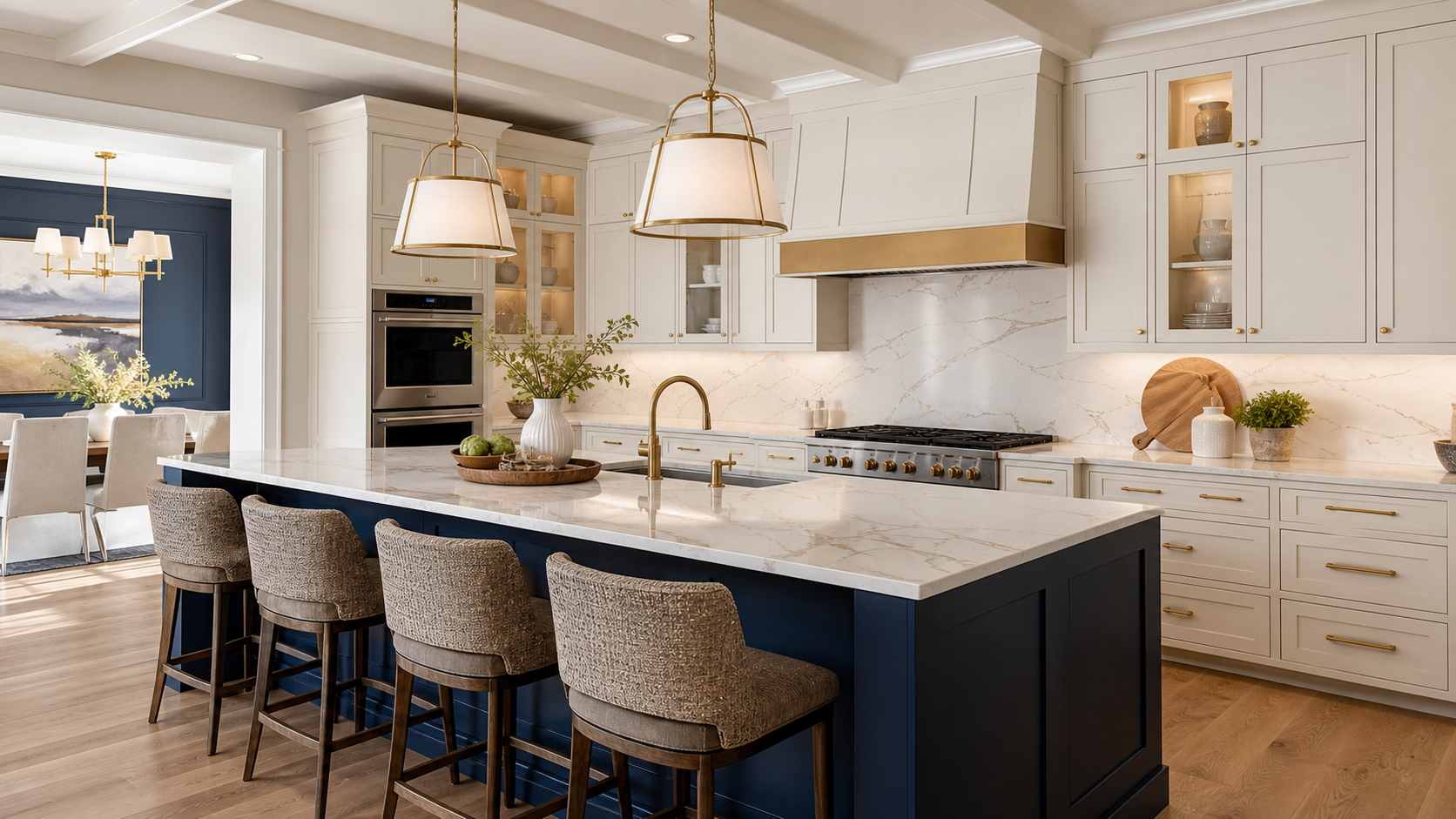
Buying a new build in Ashburn, Brambleton, or Willowsford? At some point the builder hands you a design-center appointment and a catalog, and you have a choice to make: pick from their menu, or bring in your own designer. Both can work. But they produce very different homes, and the gap is widest exactly where guests look first. Here is the honest comparison.
What’s the actual difference?
The builder’s design center sells you finishes from a fixed catalog, chosen in one or two appointments, bundled into your mortgage. Your own designer works from the whole market, plans every room to relate, and advocates for you against builder upcharges. One is a menu; the other is a custom plan tailored to how you live.
The design center exists to make selections fast and financeable, which is genuinely useful. You walk in, pick from curated options, and it all folds into your loan. The trade-off is range and objectivity. Their designers work for the builder, the catalog is limited, and the upgrade pricing is set to protect the builder’s margin. An independent designer has no catalog and no margin to protect, just your project.
Pros and cons of the builder’s design center
Pros: it is convenient, financeable, and the selections are coordinated to “work” at a basic level. Cons: limited catalog, high upgrade markups, rushed appointments, designers who answer to the builder, and a result that looks like every other house in the community. It is efficient, not personal.
Weigh it honestly:
| Builder’s design center | Your own designer | |
|---|---|---|
| Selection range | Fixed catalog | The whole market |
| Cost of upgrades | High markups | Trade pricing, fewer forced upcharges |
| Whose side they’re on | The builder’s | Yours |
| Cohesion | Room-by-room basics | Whole-home plan |
| Financing | Rolls into the loan | Paid separately |
The financing point is the one real advantage worth respecting. Builder upgrades fold into the mortgage, while your designer and many custom finishes are out-of-pocket. For some buyers that cash-flow difference matters, and a good designer will tell you which upgrades to take through the builder for that reason.
When is your own designer worth it?
Your own designer is worth it when you plan to stay in the home, when you want finishes that do not look builder-grade, or when the floor plan needs tuning before it is built. The value lands in the visible, hard-to-change choices: cabinetry, tile, lighting layout, and trim. For a short-term home, the builder’s catalog may be enough.
We have walked enough new builds to see the pattern. The rooms that disappoint a year in are almost always the ones left to the catalog: flat builder lighting, a kitchen that photographs like the model home, trim that stops at the minimum. The rooms people love are the ones where someone made deliberate, custom calls early. If you are deciding whether the investment makes sense at all, our take on whether a designer is worth it lays out where the money goes furthest.
Can you use both?
Yes, and it is often the smartest play. Hire your designer before your design-center appointment so they can tell you which upgrades to take through the builder (usually structural and behind-the-wall items) and which to skip and do better later. The designer steers the catalog choices and handles the custom finishes separately.
This hybrid is what we recommend most often. You keep the financing benefit on the items that belong in the loan, and you avoid overpaying for cosmetic upgrades you can do better after closing. The catch is timing: your designer has to be on board before that design-center appointment, which is why the question of when to hire a designer for new construction matters so much. Show up to the design center already knowing your plan and the whole appointment changes.
How the builder’s markup works
Builder upgrade pricing typically carries a markup well above retail, because the design center is a profit center, not a showroom at cost. A cabinet or tile upgrade that looks reasonable on the sheet is often priced above what the same or better finish costs through a designer’s trade sources, especially on cosmetic items you could install after closing.
You do not need exact figures to act on this; you need the principle. Behind-the-wall and structural upgrades are worth taking through the builder because doing them later means opening finished walls. Cosmetic upgrades like fixtures, faucets, and basic flooring are where the markup stings most and where you have the most freedom to do better afterward. That single distinction is most of the savings, and a designer maps it to your specific contract.
Building in Northern Virginia?
Bring us in before your design-center appointment. Shea Studio Interiors has guided new builds across NoVA for 30+ years, and we’ll tell you exactly what to upgrade through the builder and what to save for a finish that lasts.
Frequently asked questions
Is the builder’s design center a good deal?
It is convenient and financeable, but rarely a bargain. Upgrade pricing carries a builder markup, and the catalog is limited. It is a fair deal for structural and behind-the-wall items, and a poor one for cosmetic finishes you could do better and cheaper after closing.
Can I use my own designer with a production builder?
Usually yes for finishes and furnishings, though builders vary on how much they let outside designers change during construction. The most reliable approach is to use your designer to guide the design-center selections, then handle custom finishes and furniture independently after closing.
What should I upgrade through the builder?
Structural and behind-the-wall items: extra windows, ceiling height, rough-in plumbing, electrical and wiring, and anything that means opening walls to change later. These are expensive or impossible to add after closing, so the builder’s price is usually worth paying.
What should I skip at the design center?
Cosmetic upgrades you can replace after closing: light fixtures, faucets, mirrors, basic flooring, and paint. These carry the steepest markups and the most builder-grade look, and a designer can deliver better versions through trade sources for similar or less.
When do I need to hire a designer for a new build?
Before your design-center appointment, and ideally earlier, during framing. That lets the designer influence layout, lighting, and outlet placement while changes are still free, and arrive at the design center with a plan instead of reacting to a catalog under time pressure.
or call 703-891-1570