
Interior design principles · Northern Virginia
How to Choose Window Treatments and Drapery
Choose window treatments by answering four questions in sequence: How much light control do you need? How much privacy? What is the ceiling height and the window’s architectural weight? And what role should the treatment play in the room, background or statement? Sequence matters. Most people start with aesthetics and back into function. Designers work the other way.
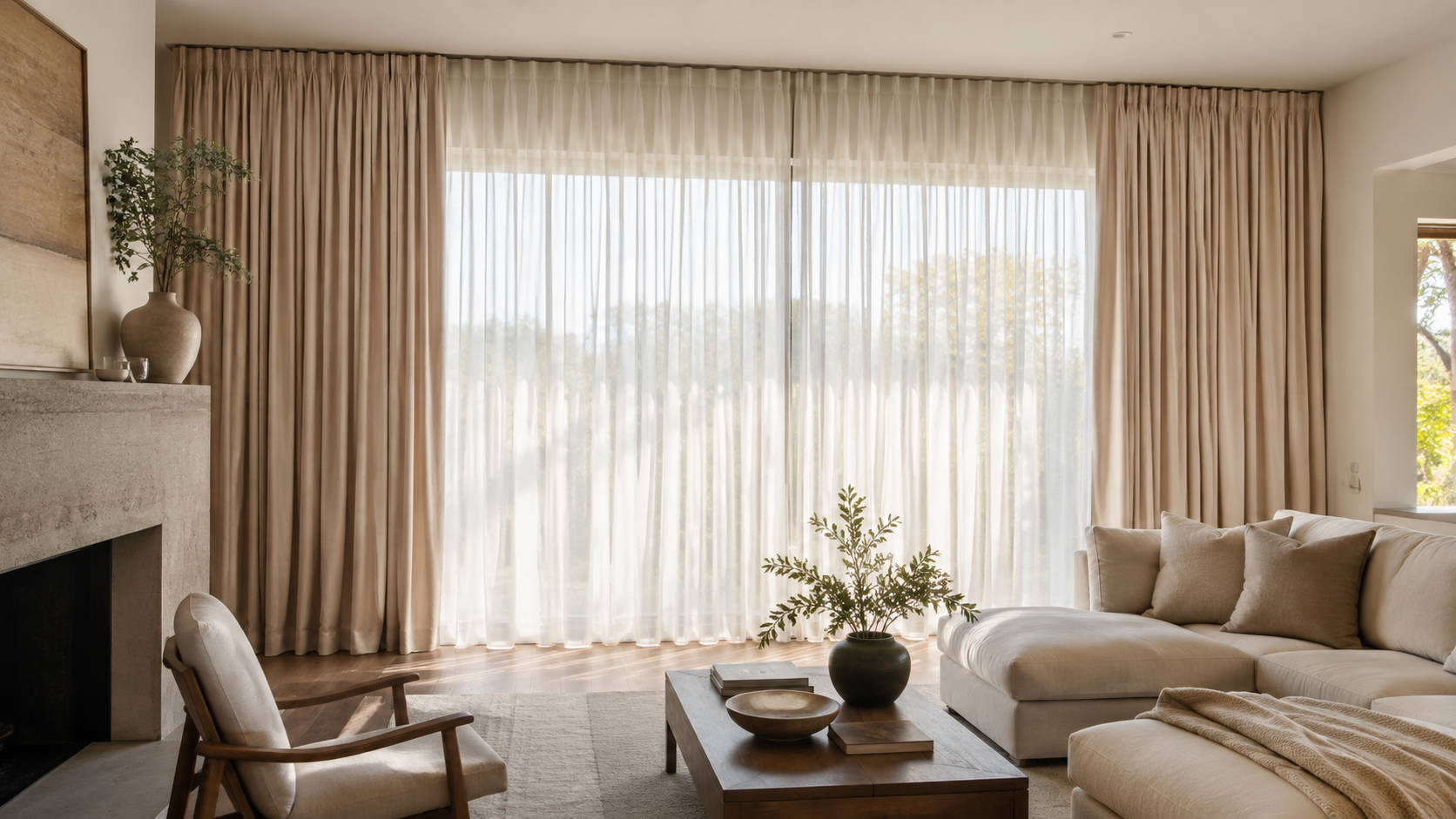
Window treatments are one of the most under-budgeted, over-simplified decisions in a home project. Clients often treat them as the last purchase, the thing you add when everything else is in place. In practice, getting the drapery wrong can flatten a room that everything else got right. And getting it right, in fabric, scale, and hanging height, is one of the least expensive ways to make a room feel finished and elevated.
After 30 years of designing Northern Virginia homes, our team has strong opinions on window treatments. Not because there’s one right answer. Because most of the guidance available online is based on trends rather than principles, and principles don’t change year to year the way trends do.
Start with function, then form
Before you choose fabric, hardware, or style, answer: what does this window need to do? Block morning sun in a bedroom? Provide full privacy in a street-facing living room? Simply soften the glass in a space that already has good shading? The function answer narrows your options dramatically and makes the aesthetic choices easier.
Light control and privacy are not the same thing, and it’s worth keeping them separate in your thinking. A sheer panel provides privacy from street-level eyes during the day while letting in full ambient light. A blackout lining blocks light but doesn’t provide any more privacy than a room-darkening shade. A layered approach, sheer closest to the glass and a heavier panel on top, handles both independently and gives you control over each.
In Northern Virginia homes, we see a few consistent patterns. South and west-facing windows in great rooms need real light control: the afternoon sun in summer is intense, and without a shade or lining, the furniture, flooring, and artwork will fade faster than you’d expect. East-facing bedroom windows need blackout capacity for anyone sleeping past 6 a.m. in spring and summer. North-facing windows often need nothing more than a soft panel to soften the cold light and frame the glass architecturally.
The single biggest mistake: hanging too low
Hang drapery at or near the ceiling line, not at the window frame. This is the most impactful single decision in window treatments and it costs nothing extra. Panels hung 2 to 4 inches below the ceiling make a room look taller and the windows look larger, regardless of the actual ceiling height or window size.
This is the rule we enforce on every project, without exception. When drapery mounts at the window frame, it caps the visual height of the room at the top of the frame. When it mounts at or near the ceiling, the eye follows the panel all the way up and the room reads as taller. It’s a perceptual trick with real, dramatic impact.
The rod or track goes as close to the ceiling or crown molding as possible. For a standard 9-foot ceiling, that’s typically 1 to 3 inches below the crown. For a vaulted or coffered ceiling, the rod tracks the architectural line rather than fighting it. The panels themselves should graze the floor or break slightly: 1/2 inch off the floor is a clean, tailored look. A 1-inch puddle is softer and more romantic. More than that becomes a practical problem.
Width is the other proportion rule. Panels should extend 12 to 18 inches beyond the window frame on each side when open, so that when they’re drawn back they don’t block any glass. A window that looks narrow because the panels eat into the glass is almost always the result of mounting too narrow. Wide, high, and long is the formula for drapery that reads as intentional.
Fabric: the choice that sets the register
Linen and linen-blend panels are the most forgiving and enduring choice for most rooms. They work across casual and formal settings, age gracefully, and don’t date. Velvet reads richer and more formal. Sheer synthetics tend to yellow or pill. Pattern adds personality but requires careful coordination with the rest of the room.
The fabric you choose does two things: it sets the visual weight of the treatment and it communicates the room’s register, how formal or relaxed the space is meant to feel. A heavy velvet panel in a deep navy makes a statement. A soft ivory linen panel recedes and lets the architecture breathe. Neither is wrong. But the choice should be intentional.
In our work, we rely heavily on linen and linen-blends for several reasons. They’re available at many price points. They take dye beautifully and hold color over time. They have enough body to hang well without being stiff or theatrical. And they work in almost every room type, from a casual family room to a formal dining room, depending on color and hardware selection.
For bedrooms, especially primary bedrooms, we almost always layer: a sheer or linen panel closest to the glass for softness during the day, and a heavier blackout-lined panel in front for night. The two panels run on the same rod or a double track. When both are open, the room fills with ambient light. When the blackout panels are closed, the room is genuinely dark.
Hardware: more visible than you think
Choose drapery hardware in a finish that coordinates with the dominant metal in the room, not necessarily the same finish. If the room uses brass as the primary metal, a brass rod ties the treatment into the palette. Mixing finishes works on hardware just as it does on cabinet hardware, as long as the combination is intentional and limited to two or three metals.
Most people treat the rod as an afterthought because it’s partially hidden behind the panel. But the finials, the rings, and the exposed rod section above the panel are visible and they communicate finish. A polished nickel rod in a room built around brushed brass reads as an accident, not a choice. A matte black rod in a room with mixed metals can be a confident punctuation mark or an awkward outlier, depending on whether black metal appears anywhere else in the space.
We typically specify rods in the dominant metal of the room. If the room hasn’t been designed yet, this is one reason to decide on a metal palette early. The hardware decision is not made in isolation. It connects to cabinet pulls, plumbing fixtures, lighting, and furniture legs. Getting all of those onto a coherent plan before anything is purchased is part of what our full-service design process does.
Shades, sheers, and panels: knowing which to combine
- Sheer panel only. Suitable for a formal living room facing a private garden, where the view is worth preserving and privacy is not a concern. Softens the window without blocking light or view.
- Shade plus stationary panels. The most common and most practical combination. The shade handles light control and privacy; the panels are purely decorative, framing the window and adding fabric softness. This works in living rooms, dining rooms, and family rooms.
- Double panel: sheer plus blackout. Best for bedrooms. Gives full control: ambient diffused light with the sheer, complete darkness with the blackout panel. Run both on a double rod or ceiling track.
- Roman shade alone. Clean, architectural, and appropriate for rooms where you want the treatment to read as part of the millwork rather than as soft furnishing. Works well in a library, a study, or a kitchen with limited wall space beside the window.
- Floor-to-ceiling panel, no shade. The most dramatic and the most commitment. Works beautifully in a room with a strong architectural backdrop, tall ceilings, and enough floor space for the panel to not feel cramped when open.
Window treatments are part of the full picture
Our team specifies window treatments as part of every interior project, coordinating fabric, hardware, hanging height, and light control with the room’s palette and architecture. Serving Northern Virginia and Metro DC for 30+ years.
Frequently asked questions
How high should I hang curtain rods?
Hang curtain rods at or near the ceiling line, not at the window frame. In rooms with standard 9-foot ceilings, mount the rod 1 to 3 inches below the crown molding or ceiling. This makes the room feel taller and the windows appear larger. The panels should graze or lightly break the floor, not float above it.
How wide should curtain panels be relative to the window?
Each panel should extend 12 to 18 inches beyond the window frame on its side when the curtains are open, so the panels stack on the wall rather than blocking glass. Total rod width is typically the window width plus 24 to 36 inches. This is how you avoid the common problem of narrow curtains that make a window look pinched.
What is the best fabric for curtains?
Linen and linen-blend fabrics are the most practical and enduring choice for most rooms. They hang well, age gracefully, and work across a wide range of room styles and formality levels. Velvet is richer and more formal. Silk is beautiful but fades quickly in direct sun. Sheer synthetics tend to yellow over time. Cotton is a good midpoint between linen and synthetic in durability and appearance.
Do I need blackout curtains in a bedroom?
If there is any direct morning sun on your bedroom windows, blackout lining is worth the small additional investment. The standard approach is a layered system: a sheer or light linen panel for daytime softness, and a blackout-lined panel in front for sleep. Both run on the same rod or a double ceiling track. When the blackout panel is open, the room reads like any other well-dressed window.
Should curtain hardware match other metals in the room?
Drapery hardware should coordinate with the dominant metal finish in the room, not necessarily match exactly. If the room uses brushed brass as the primary metal, a brushed brass rod ties the treatment into the palette. Mixing one or two metals on hardware is fine, following the same principle as mixing metals throughout the room: choose a dominant finish and let the others accent it.
Can I use the same window treatment throughout the whole house?
A consistent treatment style throughout the home creates visual cohesion, especially in open floor plans where multiple rooms are visible from a single vantage point. It doesn’t mean identical panels in every room. It means a consistent approach: the same hanging height rule, a coordinated fabric family, and a unified hardware finish. Rooms with different functions, bedroom versus kitchen, can have different treatment types while still reading as one home.
or call 703-891-1570