
Design Process · Northern Virginia
What Is a Design Concept and Why Does Your Project Need One?
A design concept is the organizing idea that makes everything in a room feel intentional rather than assembled. It’s not a mood board and it’s not a color palette, though it leads to both. It’s the decision about what your space is for and how you want it to feel. Every strong room starts there, whether you name it or not.
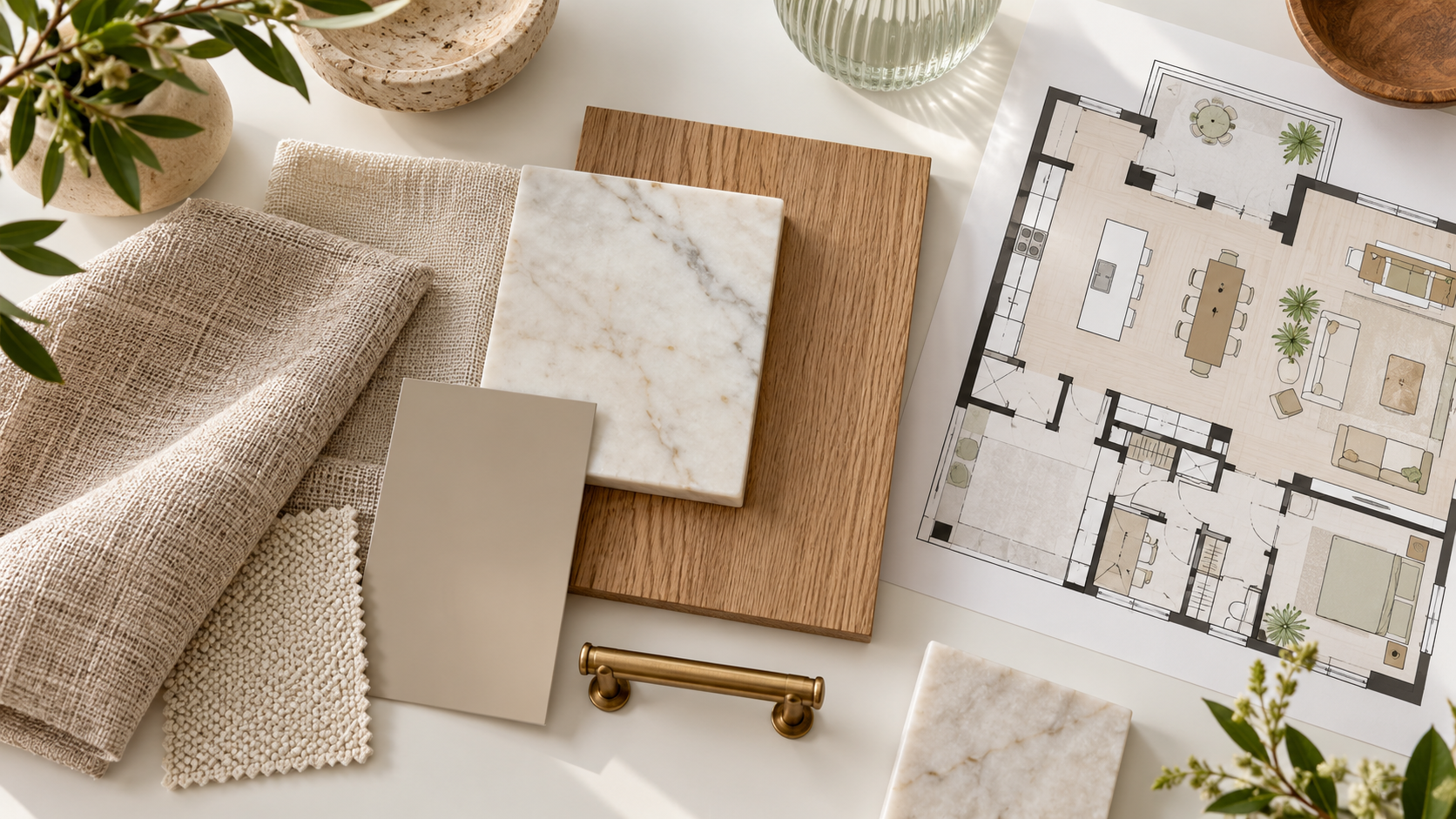
One of the most common things we hear from prospective clients is some version of this: “We have a lot of ideas, but nothing feels like it goes together.” They’ve spent months saving images. They have three Pinterest boards, two pages of paint samples, and a sofa they love but aren’t sure about. They have ingredients but no recipe.
That missing thing has a name. It’s the design concept, and once you understand what it is and what it does, you can see clearly why some rooms feel finished and some rooms just feel furnished.
What a design concept actually is
A design concept is a clearly stated organizing idea that answers two questions for a space: what is this room for, and how should it feel? It’s not a list of materials or a collection of images. It’s a decision, usually expressed in one or two sentences, that gives every subsequent choice a test to pass. If a material, a piece of furniture, or a color serves the concept, it belongs in the room. If it doesn’t, it doesn’t, no matter how beautiful it is by itself.
Here’s a practical example. A concept for a primary bedroom might be: “This room is a place for genuine rest. It should feel calm, private, and slightly removed from the rest of the house, with texture and warmth but no competing visual activity.” That’s a concept. From it, you can make a hundred decisions with confidence. The ceiling treatment should be simple and quiet. The lighting should be layered and dimmable. The textiles should be soft and tactile. Pattern, if any, should be subtle. Art should be meaningful but not demanding. Every decision either serves the concept or it doesn’t.
What a concept is not: a mood board, a color palette, a style label, or a Pinterest collection. Those things can be tools for communicating a concept, but they’re not the concept itself. A mood board full of linen, warm wood, and organic shapes might represent a concept of “quiet warmth” or it might just be a collection of pretty things that happen to look similar. The concept is the idea behind the images, not the images themselves.
What a design concept is not
A design concept is not a style label (“we’re going for transitional”), a color story (“we want warm neutrals”), or a mood board. Style labels describe surface characteristics, not purpose or feeling. A concept answers why before it answers what. A room can be transitional in style and either feel completely composed or completely scattered, depending on whether there’s an organizing idea behind it.
Style labels are one of the most common substitutes for a concept. “Modern farmhouse” is a style. “We want something cozy” is a feeling direction. “We’re looking for something clean and classic” is a preference. None of these are a concept because none of them tell you what to do when two beautiful options both fit the style but feel different in the space.
A concept gets specific. “This family room should feel relaxed and inclusive, somewhere anyone in the family actually wants to sit, not a room that adults keep pristine.” That concept immediately tells you: the sofa needs to be in a durable performance fabric, the coffee table should be robust rather than delicate, the color palette can be warm and casual, and the room probably doesn’t need a formal centerpiece. The concept is making decisions before you even open a catalog.
The other common substitute is an aesthetic reference: “We love the look of this hotel lobby” or “We want it to feel like a European apartment.” These are useful starting points, but they’re still not a concept until you articulate what specifically about that hotel or apartment speaks to you, and why it’s right for your life in your home. The designer’s job is to draw that out.
How designers develop a concept: listening and observing first
A design concept is developed through conversation, observation, and an honest assessment of how the space will actually be used. A good designer listens for what a client values, what they avoid, how they live, and what hasn’t been working. The concept emerges from those answers combined with the architectural reality of the space: its proportions, its light, its relationship to adjacent rooms.
We start every project with a conversation that has nothing to do with finishes or furniture. We ask clients how they actually use the space right now, what bothers them about it, what they want to feel when they walk in, and what they want to feel when they leave. We ask about their family, their routines, how often they have guests, whether they work from home, and whether they have children who use the space or plans to.
These questions build a picture of the life that the space needs to serve. A concept that doesn’t account for real life is a design for a photograph, not for a home. We’ve designed beautiful Northern Virginia living rooms that were also genuinely comfortable for a family with three kids and a dog, because the concept included practical durability as a non-negotiable alongside the aesthetic direction. Those rooms photograph well and they live well, because the concept carried both.
The architectural constraints of the space also shape the concept. A room with exceptional natural light leads to different concept territory than a darker room. A space with high ceilings and formal proportions sets up a different concept than one with low ceilings and informal flow. Good designers read the room before deciding what to do with it.
How a concept guides decisions throughout the project
A design concept acts as a filter for every decision in the project. When two options both look attractive, the concept tells you which one belongs. It prevents scope creep, impulse additions, and the “while we’re at it” choices that can dilute the room’s character. A concept doesn’t limit creativity; it focuses it. The best rooms feel inevitable, as if every piece was chosen to be exactly where it is.
Here’s how it plays out in practice. Early in a project, the concept is most useful as a clarity tool. It helps the client and designer get aligned quickly on what they’re building toward, so that early decisions like architectural changes, lighting rough-in, and floor selection get made with the full vision in mind rather than as isolated choices.
In the middle of a project, the concept becomes a conflict resolver. Every renovation generates unexpected conditions and budget trade-offs. When a tile option comes in over budget and you need an alternative, the concept tells you which properties of the original tile were essential (the scale? the color? the texture?) and which were incidental. You can find a better-priced option that still serves the concept rather than one that merely looks similar.
At the end of a project, the concept is what makes the room feel complete. Because every choice was tested against the same idea, the finishes, the furniture, the lighting, and the art belong to the same visual language. Nothing looks like it wandered in from a different room or a different project. That “pulled together” quality that people notice without being able to name it is the concept working in the background.
What happens without a concept: the assembled look
Without a concept, rooms accumulate rather than compose. Each individual piece may be beautiful, but the room reads as a collection of good decisions that were never connected to each other. This is sometimes called the “assembled” look, and it’s the most common thing our team is asked to fix. It often doesn’t require buying new furniture. It requires understanding what the room is trying to be and editing toward that.
We see this regularly in project consultations. A client has lived in a home for several years, adding things they liked as they found them. The sofa is beautiful. The rug is beautiful. The console is beautiful. The art is meaningful. But the room doesn’t read as a room. It reads as a storage facility for good taste.
The issue isn’t the quality of the individual pieces. The issue is that they were chosen on different days with different criteria, and no organizing idea was holding the selection process accountable. A traditional English rolled-arm sofa sits across from a mid-century credenza, under a piece of very contemporary graphic art, on a Persian-inspired rug. Any one of those elements in the right room would look wonderful. Together, without a concept to explain the dialogue between them, they compete.
The repair is usually less expensive than people fear. Often it’s about editing out two or three pieces that are fighting the room’s strongest element, and adding one or two things that serve the direction you actually want. Once you know what the room is trying to be, you know which pieces are helping and which aren’t. The concept is the diagnosis and the treatment plan together.
From concept to brief: how an idea becomes a plan
A design brief is the written form of the concept plus the practical parameters of the project: budget, scope, timeline, and specific functional requirements. The concept is the soul of the brief. The brief is what the designer works from. In a well-run project, every specification, every purchase order, and every site decision traces back to the brief, and the brief traces back to the concept.
After we develop a concept with a client, we translate it into a brief that captures both the conceptual intent and the practical requirements. For a kitchen renovation, the concept might be “efficient warmth: a working kitchen that looks and feels genuinely residential rather than commercial, with natural materials and considered light.” The brief takes that concept and adds the scope (cabinet replacement, new countertops, lighting redesign), the budget range, the timeline, and the functional priorities (storage for a serious cook, adequate prep space, seating for three).
Every decision in the project is then evaluated against both the concept and the brief. A commercial-style range hood might be efficient, but if it works against the residential warmth of the concept, there’s a better option. A tile backsplash in a vivid pattern might be beautiful, but if the concept calls for quiet texture rather than visual activity, there’s a better choice.
This is what separates a designed space from a renovated one. A renovation improves the physical condition of the room. A design gives the improved room an intention. Both are useful; only the second produces a room that feels truly finished. For more on how this process unfolds from start to finish, see our guide to the interior design process step by step.
A concrete example: concept in action
Consider a primary bedroom for a family in Northern Virginia: a busy couple who travel frequently and want the bedroom to feel like a true retreat. The concept we developed was “considered stillness”: a room that removes rather than adds, with a narrow palette, layered soft textures, intentional lighting, and no visual clutter. Every material choice, fixture selection, and furniture decision was filtered through that idea.
The concept of “considered stillness” immediately rules out a lot of things. It rules out bold accent walls. It rules out pattern-heavy textiles. It rules out a television visible from the bed. It rules out open shelving that shows personal items. It also clearly points to what belongs: linen drapery in a soft tone. Nightstands with integrated lighting to eliminate lamp clutter. A platform bed with clean lines. A soft, single-tone area rug. Art that’s meaningful but not demanding.
The palette came from the concept, not the other way around. Warm greige walls. Soft white ceiling. Natural linen textiles. Matte black fixture hardware. One piece of large-format art in muted tones. No other color. The concept determined that the room’s richness would come from texture and proportion rather than color contrast, and every selection honored that.
The finished room reads as a space that knows what it is. Visitors notice it without being able to say exactly why it feels different from other bedrooms. That unnamed quality is the concept doing its work quietly, in the background, the way a good organizing idea should.
If you want your home to have that quality, the place to start is with a designer who asks the right questions first, before any selections are made. See our overview of what working with a designer looks like in our guide on whether hiring an interior designer is worth it, and our page on how to make your home look cohesive, which covers the same underlying principle from a practical angle.
Ready to start with a real concept?
The best design projects start with a clear idea of what the space should be and how it should feel. Our team helps Northern Virginia homeowners develop that idea before any selections are made. The result is a room that looks like it was always meant to be exactly that way.
Frequently asked questions
What is a design concept in simple terms?
A design concept is a clear statement of what a space is for and how it should feel. It’s the organizing idea that connects all the decisions in a room: materials, color, furniture, light, and art. In simple terms, it answers the question “what are we building toward?” before any selections are made. A room with a strong concept feels intentional. A room without one often feels assembled.
Is a design concept the same as a mood board?
No. A mood board is a visual tool for communicating a concept, but it’s not the concept itself. A mood board shows what something looks like. A concept explains why those things belong together and what they’re in service of. You can build a mood board before you have a concept (and it often looks pretty but feels directionless) or after you have one (and it becomes genuinely useful as a reference). The concept comes first.
Do I need a design concept for a small project like repainting a room?
For something very limited in scope, like a single paint color change, a full formal concept isn’t necessary. But even then, having a clear answer to “what should this room feel like after the change?” will produce a better result than simply choosing a color you like. For any project involving multiple decisions (furniture, paint, lighting, materials), a concept is the thing that keeps those decisions connected to each other.
How does a designer come up with a design concept?
Through listening and observation, before anything else. A designer asks how you use the space, what bothers you about it currently, what you want to feel when you walk in, and what your life actually looks like day to day. The concept emerges from combining those answers with the real conditions of the space: its proportions, its light, and its relationship to the rest of the home. A concept that ignores how the space will actually be lived in is a concept for a photograph, not a home.
What’s the difference between a design concept and an interior design style?
A design style (transitional, modern, traditional, coastal) describes the surface characteristics of a room: the shapes, the finishes, the references. A concept is more specific and personal: it describes the purpose and the feeling of a particular space for a particular person. Two rooms can share the same style label and feel completely different because they’re built on different concepts. The style is a vocabulary; the concept is what you’re saying with it.
Can I develop a design concept on my own without a designer?
Yes, though it requires some disciplined self-questioning. Start by writing down, in plain language, what you want the room to be for and how you want it to feel. Not what it should look like, but what it should do and feel. Then use that statement as a filter: does this furniture choice serve those goals? Does this color? Does this material? The challenge is staying honest when a piece you love doesn’t actually serve the concept. A designer helps because they’re not attached to any particular outcome, only to whether it serves the idea.