
Interior design principles · Northern Virginia
How to Layer Lighting in a Room
Layered lighting means combining three distinct types in every room: ambient (overall brightness), task (focused work light), and accent (decorative drama). Designers add a fourth, natural light, as the foundation. Getting all four right is what separates a room that photographs well from one that actually feels good to live in.
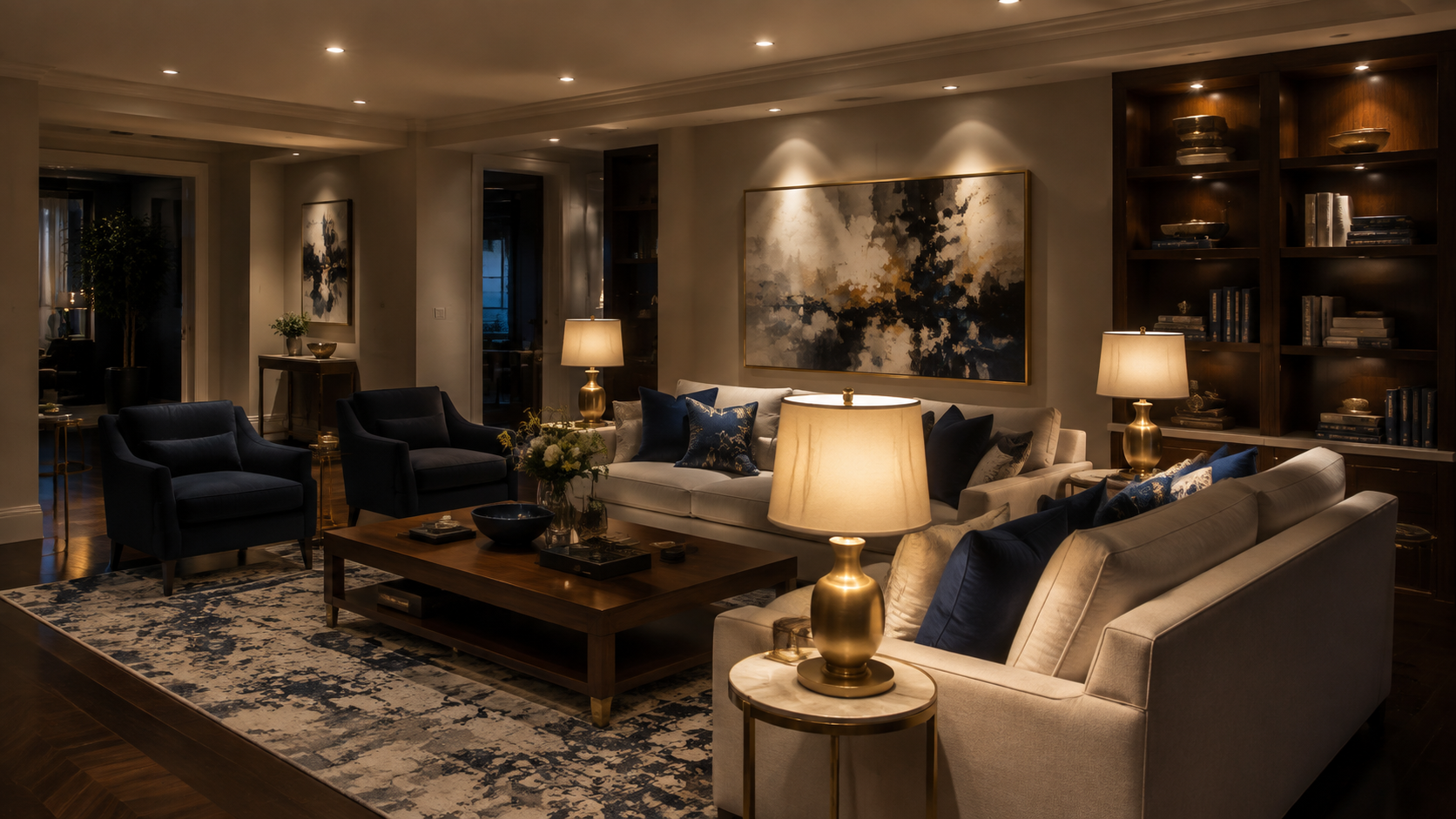
Most rooms have one problem: the overhead fixture does all the work. It bathes the space in flat, shadowless light that makes walls look smaller and faces look tired. Walk into a room that your eye immediately reads as warm, refined, and expensive, and you’ll almost always find the same thing. Not a bigger chandelier. Three or four distinct light sources working at different heights and intensities.
This is what designers mean by layering. It’s not about adding more watts. It’s about placing light at the right level, from the right source, pointed in the right direction, so the room has depth, mood, and function all at once. Our team does this on every project, from a McLean great room to a Falls Church primary bedroom, and the before-and-after impact is rarely subtle.
The three layers every room needs
Every room needs ambient light (general fill), task light (focused work), and accent light (decorative drama). Think of them as background, foreground, and punctuation. A fourth category, natural light, is the foundation you design around rather than add.
Ambient light is the baseline. It’s the recessed cans, the central fixture, the cove lighting that washes the ceiling. Its job is to make the room navigable and comfortable at any time of day, not to be exciting on its own. Designers often set ambient fixtures on a dimmer so the output can drop to a warm glow in the evening, rather than staying at full blast all day.
Task light goes where work actually happens. A reading lamp positioned beside a chair. Under-cabinet lighting in a kitchen. A swing-arm sconce at nightstand height. Task light needs to be bright enough to function without eye strain, typically 2,700 to 3,000K in color temperature, and it needs to come from the right angle so it doesn’t cast shadows across what you’re doing.
Accent light is where the personality lives. A picture light over a painting. A directional PAR lamp aimed at a textured wall. Uplights inside a built-in bookcase. Accent lighting creates the shadows and highlights that give a room visual depth. Strip it out and the space goes flat, even if ambient and task are perfect.
How to plan the layers before you buy a single fixture
Plan lighting from the room outward, not from a fixture catalog inward. Start by mapping where people sit, work, sleep, and gather. Then identify the surfaces worth highlighting and the tasks that need reliable illumination. The fixture choices come last.
This is the part most homeowners skip, and it’s where most lighting mistakes begin. They browse pendants or chandeliers, fall in love with a fixture, and then try to make the rest of the room conform to it. Designers work in reverse: activity zones first, then light sources, then fixtures.
In a living room, sketch where the sofa group sits and where conversation happens. Every seating position needs a light source within arm’s reach or just overhead, at a height low enough to create intimacy rather than stadium brightness. In a kitchen, map the countertop zones where chopping, coffee, and baking happen. Each gets its own task light, usually under-cabinet. The overhead pendants are accent and ambient, not task.
In a primary bedroom, think about both sides of the bed independently, the dressing area, any reading chair, and the approach from the door. A single overhead fixture almost never handles all of that well. A pair of wall sconces at nightstand height plus a dimmed overhead plus a floor lamp in any reading area is a more honest solution.
The dimmer rule and why it changes everything
Put every light on a dimmer. All of them. Even the ones you think you’ll always keep at full brightness. Dimmers cost almost nothing relative to the fixture they control, and they give a room the ability to shift from practical morning light to intimate evening atmosphere without any effort.
A room with four dimmable layers can look like four completely different spaces across one day. That’s not a luxury feature. It’s what makes a home feel alive rather than static. Morning, the recessed cans at 70 percent and the under-cabinet lights on. Evening, the cans at 20 percent, two table lamps on, the picture light on. The room feels completely different, and both settings are right for what’s happening in them.
The one technical note: LED bulbs and dimmers need to be compatible. Not all dimmers are rated for LED loads, and not all LED bulbs dim smoothly. When our team specifies a lighting package for a project, we always confirm bulb-to-dimmer compatibility before specifying anything. Flickering or buzzing at low dims is a common DIY misstep that’s easy to avoid by checking the manufacturer’s dimmer compatibility list.
Color temperature: the mistake that makes rooms feel cold
Use 2,700K to 3,000K throughout your home for warm, residential light. Anything above 3,500K reads as clinical or commercial. Mixing color temperatures across fixtures in the same room creates visual tension that’s hard to name but easy to feel.
Color temperature is measured in Kelvins. The lower the number, the warmer and more amber the light. A candle is about 1,800K. A standard incandescent was 2,700K. Cool white LEDs are often 4,000K or higher. In a residential setting, 2,700K to 3,000K is the sweet spot. It flatters skin, makes wood tones glow, and reads as welcoming rather than institutional.
In Northern Virginia homes, we often see mixed temperatures as a residual of renovation phases: original fixtures at 2,700K, then a kitchen remodel added 4,000K undercabinet strips, then a bathroom update brought in 3,500K vanity bars. The result is a home that feels slightly off in ways the owner can’t identify. Unifying to a single color temperature family across the home is one of the highest-return, lowest-cost corrections our team makes on projects.
| Layer | Purpose | Typical source | Placement note |
|---|---|---|---|
| Ambient | General fill and navigation | Recessed cans, central fixture, cove | Ceiling; always on dimmer |
| Task | Focused work illumination | Under-cabinet, desk lamp, sconce | At or below eye level; aimed at work surface |
| Accent | Drama, depth, focal points | Picture light, directional spot, bookcase uplight | Aimed at a surface or object, not at people |
| Natural | Foundation and mood | Windows, skylights | Design around it; control with sheers or shades |
Common layering mistakes to avoid
- Recessed cans only. A grid of recessed cans is ambient, not layered. Without table lamps or sconces, the room will always feel like a waiting room no matter how well-placed the cans are.
- All lights at the same height. Light at ceiling height only creates a flat ceiling wash. Mixing floor lamps, table lamps, and sconces at human height creates warmth and vertical dimension.
- Overhead pendants over a dining table hung too high. A pendant over a dining table should hang 30 to 34 inches above the table surface in rooms with standard 8-foot ceilings. Higher than that and it reads as ambient, not intimate.
- No dimmers on table lamps. Plug-in dimmer adapters solve this for any lamp without a built-in switch. They cost very little and change what a lamp can do.
- Mixed color temperatures in the same room. Warm and cool bulbs in the same space fight each other visually. Match all fixtures in a room to the same Kelvin range.
Lighting by room: a quick reference
Living rooms need at least four sources. Kitchens need under-cabinet task light plus ambient plus an island pendant layer. Bedrooms need bedside task light plus ambient on a dimmer. Dining rooms work best with a pendant 30 to 34 inches above the table plus one or two accent sources on the perimeter.
Living room: Central ambient fixture or cove lighting, two to three table lamps in the seating group, a floor lamp if there’s a reading chair, and one accent source aimed at artwork or architectural detail. Five sources for a well-proportioned room is not excessive. It’s the baseline.
Kitchen: Recessed ambient cans on a dimmer, under-cabinet task strips at every significant counter run, and pendants over the island that are decorative and provide ambient fill over the work surface. If there’s a breakfast nook, that zone gets its own overhead, usually a pendant or semi-flush at table height.
Primary bedroom: Overhead ambient on a dimmer, bedside wall sconces or hardwired pendants at nightstand height on individual switches, a reading lamp if there’s a seating area, and a closet light on a separate circuit. A single overhead is not enough for a room people use in the early morning and late evening at different levels of activity.
Bathroom: Vanity fixtures at face level (side of mirror, not above it) for accurate grooming light, overhead ambient on a dimmer, and a separate circuit for the shower or tub area if the fixture allows. Over-mirror fixtures cast downward shadows across the face. Side-mounted sconces at eye level are the professional solution.
Ready for lighting that actually works?
Our team designs complete lighting plans as part of every interior project, including fixture selection, dimmer specifications, and color temperature coordination throughout your Northern Virginia home.
Frequently asked questions
What are the three types of lighting every room needs?
Every room needs ambient light (general brightness for navigation and comfort), task light (focused illumination at work surfaces and reading spots), and accent light (directional or decorative sources that create depth and highlight focal points). Natural light is the fourth category and acts as the foundation you design the other three around.
How many light sources does a living room need?
A well-proportioned living room typically needs four to six sources: one overhead ambient fixture or cove, two to three table lamps within the seating group, a floor lamp for any reading position, and at least one accent source aimed at art or architecture. Five sources is a starting point for a room that functions across all times of day, not an extravagance.
What color temperature should I use in my home?
For residential spaces, 2,700K to 3,000K is the standard. This range reads as warm, welcoming, and flattering. Anything above 3,500K starts to feel clinical. Mixing temperatures across fixtures in the same room creates visual tension, so it’s worth unifying all bulbs in a space to the same Kelvin range.
Do all lights need to be on dimmers?
Every light you can put on a dimmer should be on a dimmer. Dimmers give a room the ability to shift from practical daytime brightness to intimate evening warmth without any effort. The cost of a dimmer switch is minor relative to the fixture it controls. Confirm that your LED bulbs are compatible with your chosen dimmer model before purchasing.
How high should pendants hang over a kitchen island?
Over a kitchen island, pendants should hang 30 to 36 inches above the countertop in rooms with standard 8-foot ceilings, with the bottom of the fixture at roughly 66 to 72 inches from the floor. In rooms with higher ceilings, add 3 inches of clearance for every additional foot of ceiling height. The goal is intimate pool-of-light coverage over the work surface without blocking sightlines across the island.
Where should bathroom vanity lights be placed?
Vanity fixtures work best mounted on the sides of the mirror at eye level, roughly 60 to 65 inches from the floor to the center of the fixture. This eliminates the downward shadows that an over-mirror fixture casts across the face. If a side mount isn’t possible, a wide horizontal bar directly above the mirror at 75 to 80 inches is the next best option. Avoid any fixture that points downward at the face.
or call 703-891-1570