
Design principles · Northern Virginia
How to Make Your Home Look Cohesive (A Designer’s Approach)
Make a home look cohesive by repeating a limited palette and a few materials throughout, carrying consistent undertones (all warm or all cool), keeping flooring and trim continuous, and letting one design style lead. Cohesion comes from repetition and restraint: three to five colors, one or two metals, and a single wood-tone family, used across every room.
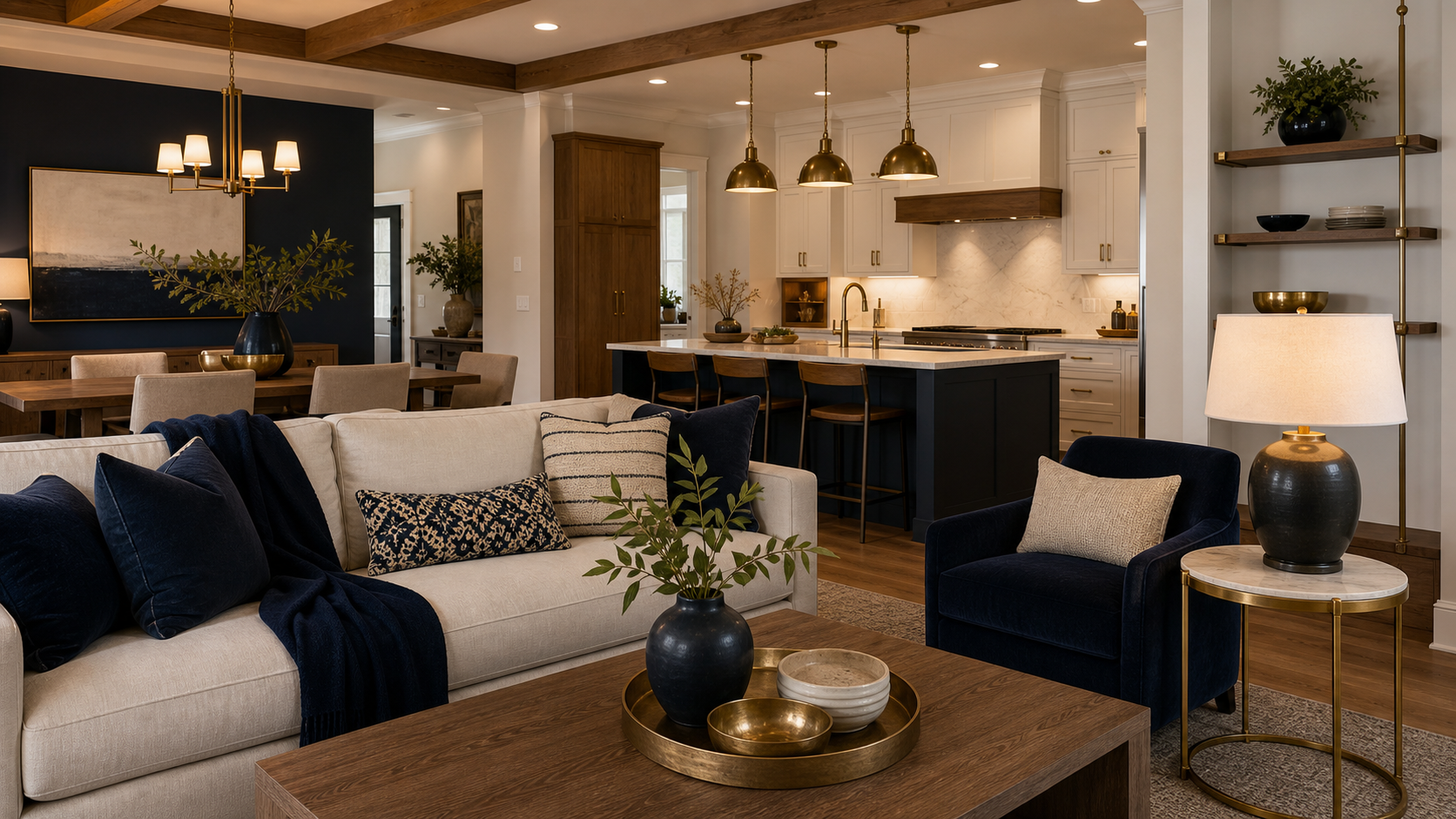
“How do designers make a home feel so pulled-together?” is the question we hear most, and the answer disappoints people because it is so simple: repetition and restraint. A cohesive home is not the most expensive one or the most decorated one. It is the one where a few deliberate choices echo through every room. Here is the actual method.
What makes a home feel cohesive?
Cohesion comes from repetition: a limited color palette, a consistent undertone, one or two metal finishes, and a single wood-tone family carried through the whole home. It also comes from restraint, resisting the urge to make every room its own statement. When the same threads reappear room to room, the eye reads the house as one intentional space.
The mistake that breaks cohesion is treating each room as a fresh project. You buy what you love for the living room, then something unrelated for the dining room, and the house becomes a collection of unrelated rooms. Designers do the opposite: they set a small kit of colors, metals, and materials at the start and repeat it everywhere, varying the proportions but not the ingredients. That repetition is what your eye reads as “expensive” and “professional,” which is why this overlaps so heavily with what makes a home look expensive.
How to choose a whole-home palette
Build a whole-home palette of three to five colors and apply the 60-30-10 rule: about 60% a dominant neutral (walls, large furniture), 30% a secondary color (upholstery, cabinetry), and 10% an accent (art, pillows, decor). Use the same palette in every room, shifting which color dominates so spaces feel distinct but related, never disconnected.
The 60-30-10 rule is the most useful color framework in design because it scales to a whole house. Pick your neutral, your secondary, and your accent once, then let each room reshuffle the ratios. The living room might lean on the neutral with accent pops, while the study goes moodier by promoting the secondary color. Same three colors, different emphasis. That is how a home feels varied and unified at once. Carry a flowering of one accent, your gold or your deep blue, lightly through every room and the whole house clicks.
Should you match metals and wood tones throughout?
Do not match exactly; coordinate. Limit yourself to one or two metal finishes used consistently (for example, brass as the star and matte black as the supporting player), and keep wood tones within one family of undertone (all warm, or all cool). Mixing is encouraged, but within rules: two to three metals max, and woods that share an undertone so they read intentional, not accidental.
This is where the “can you mix metals?” and “can you mix wood tones?” questions resolve. Yes to both, with discipline. For metals, the discipline is to choose a dominant finish and let one or two others support it, repeating that combination across rooms so the brass in the kitchen reappears in the bathroom and the lighting. For wood, the rule is undertone: a warm walnut and a warm oak live happily together, but a warm wood beside a cool gray-washed one fights. Match the undertone, vary the tone, and limit the count. That single discipline is most of what makes mixed materials look designed.
- Metals: one dominant finish, one or two supporting, repeated home-wide.
- Wood tones: keep them in one undertone family; warm with warm, cool with cool.
- Repeat, don’t match: the same finishes recurring beats everything being identical.
Warm vs cool whites: how to choose
Choose warm whites (creamy, soft) for homes with warm wood floors, brass, and south or west light, and cool whites (crisp, gray-based) for homes with cool grays, chrome or nickel, and north light. The key is to commit to one temperature and use it consistently. Mixing warm and cool whites in the same sightline is what makes a space feel subtly off.
The warm-versus-cool white question stumps people because both look fine on the chip; the problem is mixing them. A cool white trim against a warm white wall reads as a mistake even when no one can name why. Decide your home’s temperature based on your fixed elements, your floors, your metals, your natural light, and then keep every white in that family. In most Northern Virginia homes with hardwood and warmer light, soft warm whites flatter the space; commit to that and your whole palette settles. Always test whites on the actual walls, at different times of day, before you commit.
Flooring, trim, and flow between rooms
Use continuous flooring through the main living areas and a consistent trim color throughout the home; both are powerful cohesion tools because they physically connect rooms. Running the same hardwood across the main floor and repeating one trim white everywhere creates an unbroken backdrop, so your furnishings and color can vary while the architecture holds the house together.
These two are the quiet backbone of a cohesive home. Continuous flooring through the main level, rather than changing material at every doorway, makes the whole floor read as one space, which matters enormously in the open layouts common in NoVA new builds. A single trim color throughout does the same for the vertical surfaces. Get the floor and trim acting as a consistent backdrop, and you have license to be more expressive with furniture and color, because the bones are holding everything together. This is also the foundation of zoning an open-concept floor plan.
Want your whole home to feel intentional?
Cohesion is what we do. Shea Studio Interiors has pulled together whole homes across Northern Virginia and Metro DC for 30+ years, room by room, into one confident story.
Frequently asked questions
How do designers make a home look cohesive?
By repeating a small kit of choices everywhere: a limited palette of three to five colors, one or two metal finishes, and a single wood-tone family, applied with restraint. The same threads reappearing room to room, rather than each room being its own project, is what makes a home read as one intentional space.
Can you mix metal finishes in a home?
Yes, with discipline. Use one dominant metal and one or two supporting finishes, and repeat that combination across rooms, like brass as the star with matte black support. Limit it to two or three metals total. Repetition of the same mix, not random variety, is what makes mixed metals look deliberate.
Do wood tones have to match throughout the house?
They do not have to match, but they should share an undertone. Warm woods pair with warm woods, cool with cool. A warm walnut beside a cool gray-washed oak clashes, while two warm woods of different tones look intentional. Keep the undertone consistent and you can mix wood tones freely.
Should every room be the same color?
No. Use the same three-to-five-color palette throughout, but change which color dominates each room using the 60-30-10 rule. That keeps spaces distinct without disconnecting them. Identical rooms feel monotonous; unrelated rooms feel chaotic. Shared palette with shifting emphasis is the cohesive middle ground.
What is the 60-30-10 rule in interior design?
It is a color-proportion guide: about 60% of a room in a dominant neutral (walls, large furniture), 30% in a secondary color (upholstery, cabinetry), and 10% in an accent (art, pillows, decor). Applied across a whole home with the same palette, it creates rooms that feel balanced and connected.
or call 703-891-1570